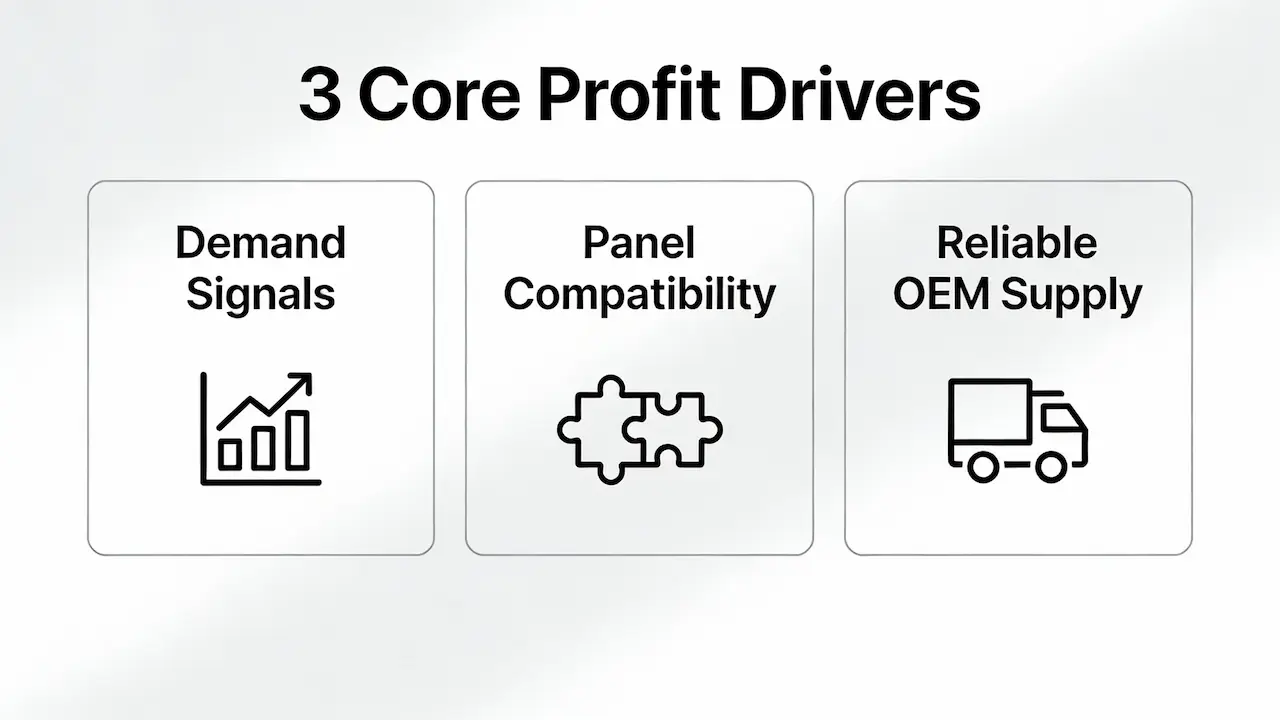
If you distribute laptop components to repair networks, e-commerce sellers, or regional resellers, your ability to profit from ASUS screens depends on three things: understanding end-user demand signals, mastering panel-level compatibility, and locking in reliable OEM supply.
Backed by 10+ years of partnerships with panel manufacturers like BOE, INNOLUX, and HKC, we supply A-grade, bulk-packed ASUS-compatible screens to 200+ distributors across North America, Europe, LATAM, and Southeast Asia. This guide cuts through consumer noise and delivers the strategic insights you need to build a scalable, high-margin ASUS screen business.
Is There Real Demand for ASUS Replacement Screens in Distribution?
Absolutely—and it’s growing.
- ASUS shipped over 8.2 million laptops globally in 2024 (IDC), making it the #4 brand worldwide.
- Screen damage accounts for 37% of all hardware repairs (iFixit Industry Report 2024).
- Top-selling series like Vivobook, TUF Gaming, and ROG have 4–6 year lifespans—creating sustained after-sales demand.
For distributors, this means: steady repeat orders from regional repair chains and online sellers who rely on you for fast, accurate fulfillment.
How Much Does It Cost to Fix an ASUS Laptop Screen? (And Why That Matters to You)
As a distributor, you don’t perform repairs—but you must understand what your customers see.
In 2025, end-users in the U.S. and EU typically pay:
- $150–$300 at ASUS Authorized Service Centers (includes labor + markup)
- $80–$200 at independent repair shops
- $60–$120 if they buy a screen online and DIY (rare, but growing)
This creates a powerful opportunity for you: repair shops need screens that let them deliver $120–$180 services while keeping parts cost under $60. Your wholesale price is their margin engine.
At [SUP], we enable this by offering:
- FHD IPS screens from $22/unit (MOQ 50)
- High-refresh ROG panels from $48/unit
- OLED touch screens from $62/unit
Your resale range? $65–$160. That’s a 130–230% gross margin—if you source correctly.
Is It Worth Getting an ASUS Laptop Screen Repaired? (Your Inventory Selection Filter)
Not all ASUS models are worth stocking. Focus on devices with high residual value, long lifespans, and broad market penetration.
Top ASUS Series for Screen Distribution (2025):
| Series | Avg. Retail Price (New) | Lifespan | Repair Demand Score* | Key Panel Examples |
|---|---|---|---|---|
| ROG / Zephyrus | $1,200–$2,500 | 4–5 years | ★★★★★ | LP160QH1-SPK1, B160QAN01.0 |
| Zenbook S/U | $900–$1,600 | 4–6 years | ★★★★☆ | B133HAN04.0 (OLED), NV140FHM-N41 |
| TUF Gaming | $700–$1,100 | 3–5 years | ★★★★★ | CLAA156WA01, B156HAN04.0 |
| Vivobook Pro/S | $600–$900 | 3–4 years | ★★★★☆ | NV156FHM-N61, B156HAK12.0 |
| ExpertBook / Business | $800–$1,300 | 5+ years | ★★★☆☆ | Steady corporate demand, lower volume |
*Based on global repair ticket volume, resale value retention, and panel availability
Avoid: Entry-level models like X415, X515MA—low resale value, high obsolescence risk.
Does ASUS Sell Replacement Screens Directly? (Your Channel Advantage)
No—and that’s your opportunity.
ASUS restricts official screen sales to its authorized service network. Even then, prices are inflated ($150+), MOQ doesn’t exist (single units only), and lead times can exceed 4 weeks.
Meanwhile, the actual panels inside ASUS laptops come from third-party factories: BOE (China), INNOLUX (Taiwan), LG Display (Korea), and HKC (China). These same factories produce identical A-grade panels for the aftermarket—just without the ASUS logo.
As a distributor, you gain three advantages:
- Price control: Source at factory cost, not retail markup
- Inventory agility: Stock 100+ units of B156HAN04.0 instead of waiting for ASUS to ship one
- Multi-brand compatibility: The same B156HAN04.0 panel fits ASUS Vivobook, Lenovo IdeaPad, and HP Pavilion—maximizing your SKU efficiency
We at [SUP] work directly with these panel lines, ensuring every batch meets ISO 9001 visual inspection standards before shipment.
Can an ASUS Laptop Screen Be Replaced? (The Standardization That Powers Your Business)
Yes—and it’s easier than ever, thanks to industry standardization.
Over 95% of modern ASUS laptops use the eDP (Embedded DisplayPort) interface with standardized mounting holes and bezel designs. This means:
- One panel model often fits 5–10 different ASUS SKUs
- Replacement doesn’t require firmware pairing (unlike Apple)
- Touch and non-touch variants are mechanically identical—only the digitizer layer differs
Real Example: The panel B156HAN04.0 (15.6″ FHD IPS, 250 nits, 45% NTSC) is used in:
- ASUS Vivobook S15 (S533EA)
- ASUS TUF Gaming A15 (FA506)
- ASUS Zenbook 15 (UX534)
- Lenovo IdeaPad 5
- HP Pavilion 15
By stocking this single SKU, you serve multiple brands and models—reducing inventory complexity while increasing turnover.
Specialty Screens: Where Your Highest Margins Live
Don’t just stock basic FHD panels. Premium segments drive profitability:
- High-Refresh (144Hz–165Hz): ROG and TUF Gaming models. Resale: $120–$160. Your cost: $48–$58.
- OLED Touch: Zenbook S 13/14. Resale: $150–$190. Your cost: $62–$72. Watch for digitizer fragility—offer full assembly only.
- Low-Power IPS (for Business Laptops): ExpertBook series. Steady demand, lower return rates.
We maintain dedicated buffer stock for these segments—with minimum 90-day inventory coverage to prevent out-of-stocks during Q4 peak.
Why Not Source from Amazon or Grey Market?
Because your reputation is on the line.
- Amazon/eBay sellers mix A-grade, B-grade (minor backlight bleed), and refurbished panels. No batch traceability.
- Grey-market suppliers often repackage returned or rejected units. Warranty claims get denied.
- OEM partners like [SUP] provide:
- 100% new A-grade panels in original anti-static packaging
- Batch-specific COA (Certificate of Authenticity)
- 12-month warranty with clear RMA process
- DDP shipping to your warehouse (no hidden import fees)
Your downstream customers expect consistency. One bad batch can lose you a key account.
Series-Specific Opportunities
ASUS laptop screen demand varies significantly across product lines. To help distributors optimize inventory and margin strategy, we’ve created dedicated wholesale guides for each major series:
- ASUS ROG Screen Wholesale Guide – High-refresh, OLED, and QHD panels for premium gaming models (2018–2025).
- ASUS TUF Screen Wholesale Guide – 144Hz FHD panels, rugged design compatibility, and bulk pricing for value-focused gamers.
- ASUS VivoBook Screen Wholesale Guide – Cost-effective FHD/TN/Touch panels for education, SMB, and high-volume repair markets.
Understanding panel specifications like interface type (eDP 40-pin vs 30-pin), brightness (nits), color gamut (sRGB/DCI-P3), and quality grade (A vs B) is critical when sourcing ASUS screens at scale. For a full technical breakdown of these parameters—and how to verify compatibility before ordering—refer to our industry reference:The Complete Guide to Laptop Display Specifications in 2025.
Conclusion: Become the Trusted ASUS Screen Partner for Your Region
Distributing ASUS replacement screens isn’t about moving parts—it’s about becoming the strategic inventory partner your customers rely on for uptime, accuracy, and margin.
At [SUP], we specialize in serving distributors who need:
- ✅ 1,200+ ASUS-compatible models in active production
- ✅ Tiered pricing (MOQ 10 for sampling, 50+ for best rates)
- ✅ Real-time panel cross-reference tool (by laptop model or OEM part number)
- ✅ Quarterly supply agreements with price-lock options
Ready to build or expand your ASUS screen business?
→ Request a customized volume quote for your top 10 SKUs
→ Schedule a 15-minute supply chain review with our B2B team
Your growth depends on reliable supply. We ensure you never miss a sale due to stockouts, compatibility errors, or quality issues.