Imagine this: A B2B distributor receives a bulk order for HP Pavilion Chromebook 14 screens, only to discover 30% of the panels are incompatible with the customer’s specific models. The issue? They ordered screens based on size alone, ignoring critical differences in eDP interface pin counts and OEM firmware requirements. This costly mistake could have been avoided with proper technical guidance.
Many screen buyers rely on simple searches like “14-inch Chromebook screen” or “HP Pavilion replacement,” but these generic queries often lead to mismatched parts. The reality is that screen compatibility depends on far more than just physical dimensions. Key factors include eDP interface pin count, panel type (TN vs SVA), touch support, and OEM firmware compatibility.
There are two common failure points in Chromebook screen procurement:
- Physical size matches but electrical specifications differ (e.g., 40-pin vs 30-pin eDP interfaces)
- Ignoring sub-model variations that result in missing touch functionality or brightness control issues
Let’s break down what truly determines screen compatibility for the HP Pavilion Chromebook 14, starting with its official specifications.
What is HP Pavilion Chromebook 14 series overview?
The HP Pavilion Chromebook 14 series was introduced in 2013 as an entry-level education and business laptop line. It features a 14-inch form factor with Chrome OS, targeting cost-conscious buyers who prioritize portability and cloud-based computing.
Key screen features include:
- 14-inch TN panel with 1366×768 resolution
- 200-220 nits brightness for indoor use
- 60Hz refresh rate for basic productivity tasks
- Optional touch support on select models
According to the HP Maintenance and Service Guide (2013) , the series uses panels from multiple OEM suppliers including BOE, LG Display, and AU Optronics.
How are HP Pavilion Chromebook 14 models named?
The HP Pavilion Chromebook 14 uses a specific naming convention that indicates regional variants and feature sets:
- 14-c010us: The “us” suffix indicates a US market model with standard non-touch screen
- 14-c001ef: The “ef” suffix indicates a European model with SVA panel technology
- 14-c002ea: The “ea” suffix indicates a Eurasian model with TN panel
- 14-c002sa: The “sa” suffix indicates a South African model with LVDS interface
- 14-q030sg: The “sg” suffix indicates a Singapore model with anti-glare coating
What is exact screen model used in the HP Pavilion Chromebook 14?
| Model Variant | Panel Model | Size | Resolution | Refresh Rate | Brightness | Panel Type | Touch? | Interface |
|---|---|---|---|---|---|---|---|---|
| HP Pavilion 14-c010us | M140NVF7 | 14.0 inch | 1366 x 768 | 60Hz | 200 nits | TN | No | eDP 40-pin |
| HP Pavilion 14-c001ef | NT140WHM-N34 | 14.0 inch | 1366 x 768 | 60Hz | 220 nits | SVA | No | eDP 30-pin |
| HP Pavilion 14-c002ea | B140XTN02.E | 14.0 inch | 1366 x 768 | 60Hz | 220 nits | TN | No | eDP 30-pin |
| HP Pavilion 14-c002sa | N140BGE-L42 | 14.0 inch | 1366 x 768 | 60Hz | 200 nits | TN | No | LVDS 40-pin |
| HP Pavilion 14-q030sg | Information not available | 14.0 inch | 1366 x 768 | 60Hz | 220 nits | TN | No | eDP 30-pin |
What are key technical specifications of the HP Pavilion Chromebook 14 panel?
- Display Size: 14.0 inch (35.56 cm) diagonal
- Resolution: 1366 x 768 (WXGA HD)
- Panel Type: TN (Twisted Nematic) or SVA (Super Vertical Alignment)
- Brightness: 200-220 nits
- Refresh Rate: 60Hz
- Touch Support: Optional on select models
- Interface: eDP 30-pin or eDP 40-pin depending on sub-model
According to Panelook database, the M140NVF7 panel used in the 14-c010us model has a contrast ratio of 600:1 and 45% NTSC color gamut.
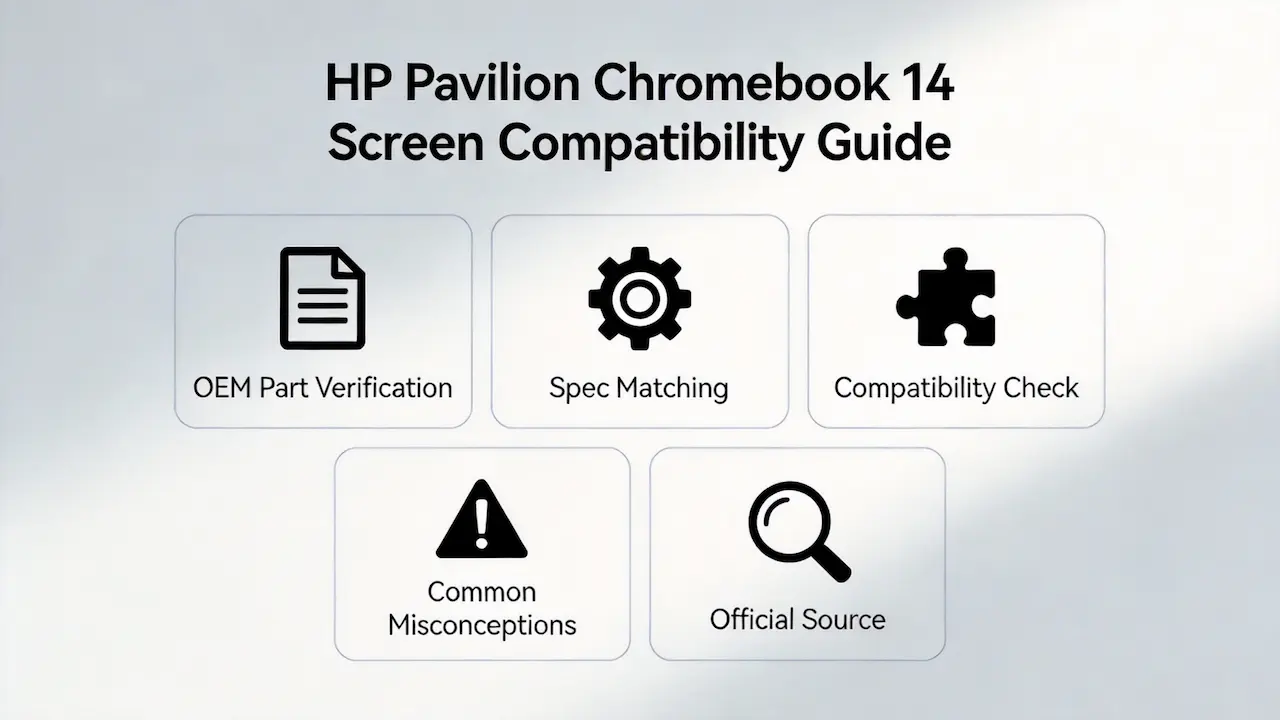
What are common misconceptions when purchasing the HP Pavilion Chromebook 14 series screen panel?
- Misconception 1: All 14-inch Chromebook screens are interchangeable
- Reality: The 14-c002sa uses LVDS 40-pin interface while other models use eDP interfaces, making them incompatible.
- Misconception 2: Touch and non-touch screens can be swapped
- Reality: Touch-enabled models require specific panels with digitizer layers and matching firmware.
- Misconception 3: All HP Pavilion Chromebook 14 models use the same panel
- Reality: Sub-models use different panel types (TN vs SVA) and interface configurations.
Where can I verify screen compatibility before ordering?
- HP PartSurfer: Enter your laptop’s serial number to find the exact OEM screen part number
- Panelook Database: Search by panel model number to verify technical specifications
- iFixit Compatibility Guide: Check community-contributed screen replacement information
- Official Service Manual: Download from HP support website for detailed component specifications
Frequently Asked Questions (FAQ)
Can Chromebook 14 screens be repaired?
Chromebook screens can be replaced with compatible OEM panels. It is recommended to match the exact panel model and interface specifications for proper functionality.
How much money is it to repair a Chromebook 14 screen?
Screen replacement costs typically range from $35 to $80, depending on the specific model and supplier. Bulk orders may qualify for discounted pricing.
What screen does HP Pavilion Chromebook 14 use?
Most models use 14-inch TN panels with 1366×768 resolution and eDP interfaces. Specific panel models vary by sub-model.
Is HP Pavilion Chromebook 14 screen touch?
Some newer models in the 14-ca series support touch functionality, but the original 14-c000 series models are non-touch only.
Conclusion
We are distributors of BOE, LG, Samsung, AUO, Innolux, and Sharp screens, providing OEM-quality panels for HP Pavilion Chromebook 14 series. Our extensive inventory includes both TN and SVA panels with various interface configurations to match your specific model requirements.
As a B2B supplier, we offer flexible MOQ (minimum order quantity) starting at 10 units, ensuring you can get the exact panels you need without overstocking. All our screens come with a 30-day replacement warranty and guaranteed compatibility with your HP Pavilion Chromebook 14 models.
Contact us today for bulk order inquiries and let us help you avoid costly compatibility mistakes. Our technical team is ready to assist with panel selection and compatibility verification.