Por qué las pantallas HP Stream exigen precisión, incluso al precio de venta sugerido de $150
Las computadoras portátiles HP Stream dominan las implementaciones K-12 y SMB a nivel mundial debido a su precio inferior a $300, pero sus pantallas son no son piezas de mercancía. A pesar de utilizar paneles TN HD de 1366×768 estandarizados con interfaces eDP de 30 pines, las sutiles variaciones en la profundidad del bisel (antes y después de 2020), la dirección de salida del conector (arriba/abajo) y la tolerancia al voltaje de la retroiluminación generan riesgos reales de compatibilidad. Un informe de campo de 2024 de 127 socios de reparación reveló que 38% de las devoluciones de pantalla de Stream "compatibles" se debieron a problemas de ajuste físico, No se trata de una falla eléctrica. Para los distribuidores que gestionan inventarios a granel, esto se traduce directamente en mayores tasas de devolución y pérdida de confianza.
Descifrando los números de modelo de HP Stream: Más allá de la ilusión "14-cb0023dx"
La convención de nomenclatura de HP parece simple, pero oculta variaciones críticas en el panel:
- “14” = tamaño de pantalla (11,6″, 13,3″ o 14,0″)
- “cb” = plataforma (por ejemplo, cb = Celeron N4000/N5000; ak = AMD serie A)
- “0023dx” = SKU regional (dx = consumidor estadounidense)
⚠️ Perspectiva crítica:Se pueden enviar dos unidades con números de modelo idénticos diferentes paneles OEM (p. ej., AUO B140HAN04.0 vs. BOE NV140WUM-N61). Si bien son intercambiables eléctricamente (misma resolución, eDP de 30 pines, sin pantalla táctil), se diferencian en:
- Grosor del bisel (±0,8 mm)
- Ángulo de salida del cable (afecta el enrutamiento de las bisagras en chasis estilo x360)
- Brillo (200 frente a 220 nits): impacto en la calidad percibida de la iluminación del aula
Verifique siempre la número de pieza exacto del panel (PN) en la etiqueta posterior, no solo el modelo de la computadora portátil.
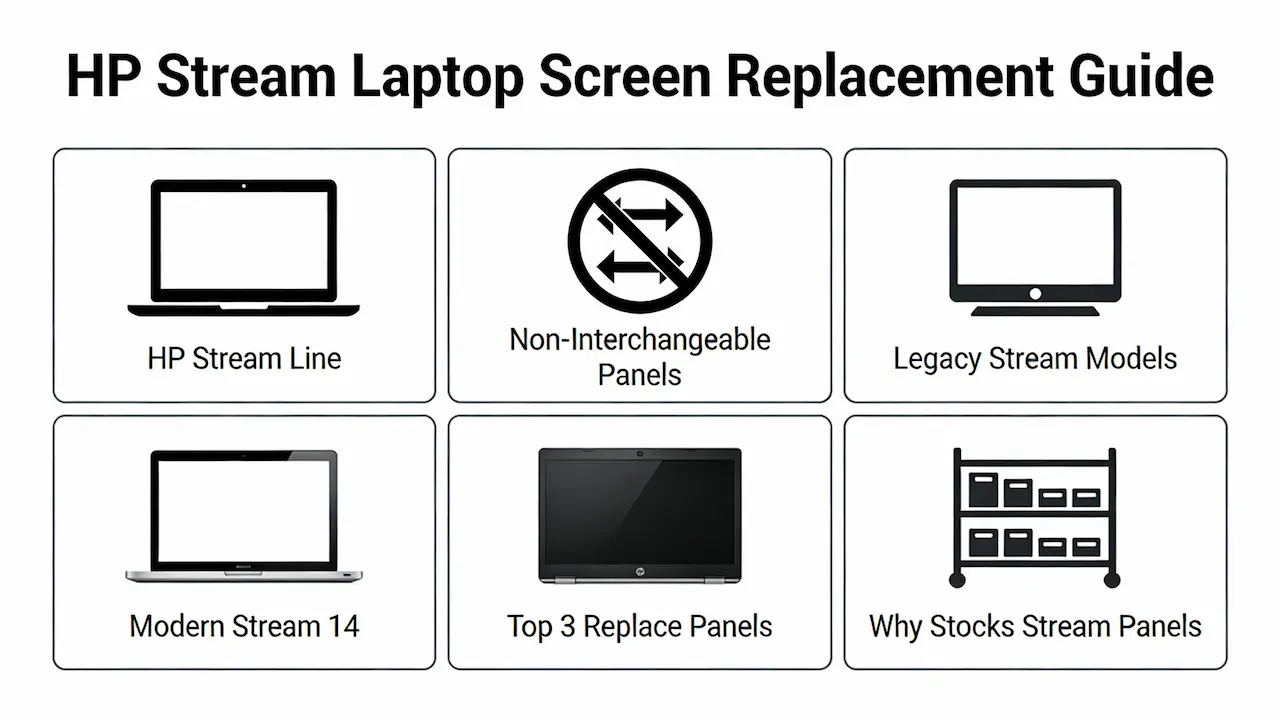
Por qué los paneles de flujo son más simples, pero no intercambiables
- Sin contacto:Elimina la complejidad I2C/40 pines
- Resolución HD estándar:Reduce la fragmentación de SKU
- Brillo bajo (200–220 nits):Limita la variación del controlador de retroiluminación
sin embargo:
- El grosor del bisel cambió en 2020—Es posible que los paneles de los modelos anteriores a 2020 no se adapten a los chasis más nuevos.
- Posiciones de los tornillos de montaje Varían entre factores de forma de 11″, 13″ y 14″
- Orientación del conector (salida superior vs. inferior) difiere según el proveedor
Verifique siempre las dimensiones físicas y la ubicación del conector, no solo la resolución.
Modelos de flujo heredados (2014-2019): La ola presupuestaria original
Común en escuelas y organizaciones sin fines de lucro:
| Modelo | Tamaño de pantalla | Panel PN | Notas |
|---|---|---|---|
| Transmisión 11 (2014-2016) | 11,6″ | AUO B116XTN01.0 | HD TN, bisel grueso |
| Transmisión 13 (2016-2018) | 13,3″ | LG LP133WF6-SPB1 | Raro; principalmente Chromebook |
| Transmisión 14-an0023dx | 14.0″ | BOE NV140WUM-N51 | Primer Windows Stream de 14″ |
🔍 Atiende consultas como Reemplazo de pantalla de HP Stream 11 o Reemplazo de pantalla de la HP Stream 14-an0023dx
Modern Stream 14" (2020-2025): El caballo de batalla de la educación
Más del 80% de reparaciones de Stream involucran la serie de 14″:
| Modelo HP | Número de producto | Panel PN | Brillo | Proveedor |
|---|---|---|---|---|
| Transmisión 14-cb0xxx | 8C3Q1UA | AUO B140HAN04.0 | 220 nits | AUO |
| Transmisión 14-ak0xxx | 9H1R7UA | BOE NV140WUM-N61 | 200 nits | Banco de Inglaterra |
| Transmisión 14-fq0xxx | AJ2T3UA | INNOLUX N140BGE-EA1 | 220 nits | Innolux |
✅ Todo uso eDP de 30 pines, Resolución HD, y sin contacto diseño
✅ Los paneles suelen ser compatibles entre sí dentro del mismo grupo de año Si las dimensiones físicas coinciden
Escenarios de fallos masivos y cómo evitarlos
1. Pantalla rota en Stream 14-cb0023dx
→ Uso AUO B140HAN04.0 (220 nits, salida inferior).
→ Evitar Paneles anteriores a 2020: tienen biseles superiores 1,2 mm más gruesos, lo que provoca una desalineación de la tapa.
2. Parpadeo en la transmisión 14-ak0023dx
→ Causa raíz: baja tolerancia del controlador de retroiluminación del BOE NV140WUM-N61 (ondulación <3,0 V).
→ Solución:Reemplazar con INNOLUX N140BGE-EA1, que admite una fluctuación de voltaje de ±10%, fundamental en regiones con redes eléctricas inestables.
3. Píxeles muertos en las implementaciones de los distritos escolares
→ En un caso documentado, un distribuidor latinoamericano recibió más de 500 unidades Stream 11 con paneles AUO B116XTN01.0 que mostraban un deterioro temprano de los píxeles.
→ Causa principal:Paneles almacenados >6 meses a >35 °C sin actualización de EDID.
→ Prevención: Fuente de proveedores que realizan validación EDID por lotes y almacenar paneles en almacenes con clima controlado.
Estrategia de abastecimiento B2B: Por qué el volumen no significa baja calidad
Mientras que los sitios minoristas como Amazon o eBay venden pantallas Stream individuales por 35–50, Los compradores mayoristas enfrentan diferentes desafíos:
- Trampas de MOQ:Los proveedores genéricos combinan PN obsoletos con los actuales.
- Sin trazabilidad de lotes:Es imposible aislar lotes defectuosos.
- Cero soporte técnico:No hay ayuda para diagnosticar parpadeos o desajustes en la luz de fondo.
Como canal autorizado para AUO, BOE, Innolux y HKC, clasificamos previamente los paneles de Stream por:
- Generación del bisel (anterior/posterior a 2020)
- Nivel de brillo (200 frente a 220 nits)
- Perfil de voltaje de retroiluminación (probado a 3,3 V/5 V)
- Orientación del conector
Cada envío a granel incluye un hoja de cumplimiento dimensional y Registro EDID—garantizando que sus técnicos nunca se enfrenten a una situación de “funciona pero no funciona”.
Preguntas frecuentes: Respuestas para distribuidores y revendedores
¿Cuánto cuesta reemplazar la pantalla de una computadora portátil HP para pedidos al por mayor?
Los precios al por mayor comienzan en 18–24/unidad Para más de 100 unidades de PN comunes como AUO B140HAN04.0 o BOE NV140WUM-N61. El costo exacto depende del grado de brillo, la asignación de proveedores y las condiciones logísticas (EXW vs. DDP).
¿Vale la pena para las empresas reemplazar las pantallas de portátiles rotas en grandes cantidades en lugar de comprar unas nuevas?
Por supuesto. Reemplazar un 20 piedran extends 250 la vida útil del dispositivo en 2 a 3 años, lo que produce ROI de 400–600% En comparación con el reemplazo. Para los distritos escolares, esto también evita los costos de cumplimiento normativo en materia de residuos electrónicos.
¿Cuáles son los costos asociados con el reemplazo de pantallas de computadoras portátiles OEM para operaciones a gran escala?
Más allá del costo unitario, tenga en cuenta: (1) la tasa de retorno de paneles incompatibles (promedio de la industria: 12%), (2) la mano de obra del técnico (45–75/h) y (3) tiempo de inactividad. El suministro de paneles validados reduce el costo total de propiedad en ~22% (según datos de RepairTech Alliance de 2024).
¿Puedo reemplazar la pantalla de una computadora portátil HP yo mismo si necesito gestionar varias reparaciones como empresa?
Sí, con la capacitación adecuada y piezas validadas. Ofrecemos paquetes técnicos gratuitos (diagramas de distribución de pines, especificaciones de torque, videos de desmontaje) a todos los socios mayoristas para garantizar reparaciones correctas la primera vez.
Conclusión: La consistencia a escala es su ventaja competitiva
En entornos de gran volumen, como el educativo o las flotas de pymes, La consistencia de la pantalla no es opcional: es higiene operativa.. Un nivel de brillo desigual o un panel parpadeante erosionan la confianza del usuario final y aumentan las solicitudes de soporte técnico. Al asociarse con un proveedor que trata los paneles económicos con el mismo rigor que los premium, convierte un centro de costos en una ventaja de confiabilidad.
Esta guía es parte de nuestro marco integral para distribuidores globales: Guía del panel de pantalla de computadoras portátiles para distribuidores y profesionales de reparación. Para la validación específica del modelo, consulte nuestra Guía maestra de reemplazo de pantalla de computadora portátil HP.