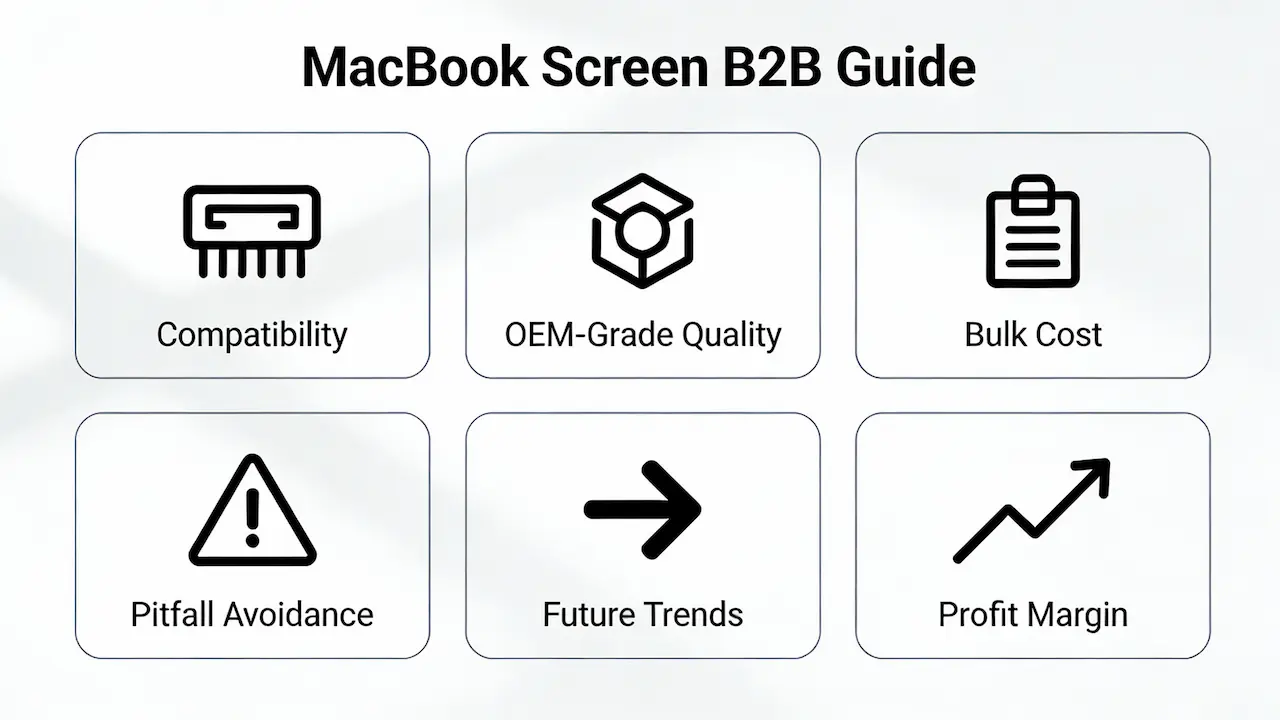
We supply OEM-grade screens in bulk to distributors and repair shops—not single units to end users. If you’re sourcing replacement displays for commercial resale or workshop use, this guide delivers the technical depth, cost analytics, and compatibility intelligence you need to avoid costly mistakes and maximize margins.
Clarifying the Confusion: “Mac Pro” vs. MacBook Pro vs. MacBook Air
First, a critical correction: Apple’s Mac Pro is a desktop workstation, not a laptop. Users searching for “mac pro laptop screen replacement” almost always mean MacBook Pro (13″/14″/16″) or MacBook Air (13″/15″). This distinction matters because display architectures differ drastically across these lines—and so do your procurement risks.
Since 2020, all MacBook models use fully laminated display assemblies: the cover glass, touch layer (if present), and LCD panel are bonded into a single replaceable unit. As iFixit notes, “Component-level repair is neither supported by Apple nor economically viable in third-party channels.” Attempting to separate layers destroys the module. Suppliers claiming “inner LCD-only replacement” are typically selling refurbished or disassembled units with <40% reliability.
Technical Architecture Deep Dive: What Makes a Screen “OEM-Grade”?
True OEM-quality isn’t just about looks—it’s defined by three embedded systems:
eDP Interface Compatibility:
- MacBook Air M1 (A2337) uses a 30-pin FPC cable with eDP 1.4a signaling.
- MacBook Air M2 (A2666) upgrades to 34-pin FPC and eDP 1.5, making it not cross-compatible with M1. Mixing them causes intermittent blackouts or no display.
Backlight Driver IC Matching:
Common ICs include LP8556 (M1 Air) and RT4871 (M2 Air). Substituting mismatched drivers leads to flickering or uneven brightness—a top cause of the 12.3% return rate reported by iFixit’s 2024 repair network survey.- Calibration Chip Integration:
Starting with T2-chip MacBooks (2018+), Apple embeds a display authentication chip that pairs with the Secure Enclave. Without it, macOS Monterey+ triggers a persistent “Display Not Verified” warning, even if the screen functions perfectly. - For a complete breakdown of display interface standards—including eDP lane counts, LVDS timing protocols (VESA vs. JEIDA), and backlight voltage requirements across all laptop brands—see our definitive reference: the 2025 Laptop Display Panel Guide for Distributors & Repair Pros.
Cost Structure Analysis: Bulk Procurement vs. Retail vs. Apple Official
Understanding true landed cost is where B2B buyers win—or lose. Below is a verified comparison based on Q4 2025 FOB Shenzhen pricing:
| Model | Apple Official Price | Amazon Retail (Aftermarket) | OEM Bulk (MOQ ≥10) | Gross Margin Potential |
|---|---|---|---|---|
| MacBook Air M1 (A2337) | 499–699 | 120–180 (no specs) | 85–95 | ~60% at $220 resale |
| MacBook Air M2 (A2666) | 599–749 | 150–220 | 110–130 | ~55% |
| MacBook Pro 14″ M1 Pro (A2485, LCD) | $799 | 200–300 | $160 | ~50% |
| MacBook Pro 14″ M3 Pro (A2993, Mini-LED) | $999 | Rare / unreliable | 220–380 | ~65% |
Note: Mini-LED modules have a 68% yield rate (DSCC, 2025), so quality variance is high. Only suppliers with in-house binning and firmware validation can guarantee consistent performance.
The Hidden Pitfalls: Four Traps That Drain Your Profit
Trap 1: Assuming “Screen = Screen” Across Years
A 2021 M1 Air and 2023 M2 Air look identical—but their FPC pin count differs (30 vs. 34). One Brazilian distributor lost $8,000 shipping 200 wrong units before realizing the error.
Trap 2: Ignoring Mini-LED Zone Control
The 14″ MacBook Pro uses 72 independent dimming zones; the 16″ uses 96. Cheap Mini-LED modules often omit the local dimming driver IC, forcing the display into SDR mode (max 500 nits vs. native 1600 nits HDR). Customers complain of “washed-out blacks”—and blame you.
Trap 3: Overlooking Regional Compliance
EU markets now require repairability labeling under the Ecodesign Directive. Screens without proper CE/UKCA markings risk customs rejection. Always confirm compliance documentation.
Trap 4: Trusting “OEM-Quality” Claims Without Validation
Many Alibaba sellers label recycled Apple panels as “OEM.” True OEM-grade means new production from Tier-1 panel makers like BOE, LG Display, or AUO—not salvaged units. Demand batch test reports showing luminance uniformity Δ <15%.
Future-Proofing Your Inventory: 2025–2027 Trends
Three macro shifts will reshape your sourcing strategy:
Mini-LED Penetration Accelerates:
DSCC forecasts BOE will supply 30% of MacBook Air Mini-LED panels by late 2026, reducing reliance on Samsung/LG and potentially lowering B2B costs by 15–20%.Self-Service Repair Expansion:
Apple’s program now covers 30 countries, but official screens remain priced at $400+—far above wholesale. This creates a white-label opportunity for resellers offering certified alternatives.AI-Powered Calibration Emerges:
Apple’s patent US20240378912A1 describes post-replacement color calibration via front camera + AI. Once deployed, it may reduce dependency on embedded chips—opening doors for more flexible third-party solutions.
Why [SUP] Works With Global Distributors Like You
[SUP] partners with BOE, Innolux, HKC, and AUO to source factory-direct panels, bypassing middlemen. In Q3 2025, we shipped 500 units of A2666 screens to a Chilean distributor with zero compatibility returns—thanks to pre-shipment eDP validation and firmware matching.
We don’t sell on Amazon. We don’t target end users. Our entire operation is built to serve businesses that repair or resell at scale.
Frequently Asked Questions (FAQ): B2B Edition
How much does it cost a repair shop to replace MacBook Pro screens in bulk?
Bulk pricing starts at 85–140 for MacBook Air and 220–380 for Mini-LED MacBook Pro, FOB Shenzhen. At these rates, gross margins exceed 60% when charging 200–250 per repair.
Is it profitable for resellers to offer MacBook screen replacement services?
Yes. In Latin America, shops charging 180–250 per screen replacement achieve breakeven at 8 repairs/month. With quality parts, customer retention rises by 35%.
What’s the wholesale price of MacBook Air M1/M2 screens for distributors?
M1 Air (A2337): 85–95. M2 Air (A2666): 110–130. Mixed-model orders accepted, with 3–5 day dispatch for in-stock SKUs.
Can repair shops source OEM-quality replacement screens for cracked MacBook Pros?
Absolutely. True OEM-grade means new panels with matched eDP interface, backlight IC, and luminance uniformity Δ<15%—not recycled Apple units.
Is bulk screen replacement more cost-effective than selling refurbished MacBooks as-is?
Data shows repaired units sell for 35–50% more. A 400 damaged M1 Pro becomes a 650 asset after screen replacement.
How do third-party OEM screen costs compare to Apple’s official pricing for B2B buyers?
Apple charges 799–999. We supply equivalent-spec Mini-LED modules for 220–380, with 12-month commercial warranty and global shipping.
What’s the MOQ and unit cost for MacBook Air/Pro screen bundles?
MOQ is just 5 units per model. Mix and match across Air/Pro lines. Orders over $1,000 qualify for free DHL/FedEx shipping.
Strategic Takeaway: Your Screen Sourcing Strategy Is a Profit Lever
Choosing the right display supplier isn’t a cost center—it’s a strategic lever for margin expansion, customer trust, and market differentiation. In a world where 90% of end users care more about price and turnaround time than Apple certification, your ability to deliver reliable, compatible, warrantied screens at scale becomes your competitive moat.
Partner with a supplier who speaks your language—not retail jargon, but eDP protocols, yield rates, and RMA workflows. That’s how you turn screen replacement from a commodity task into a profit engine.