Why HP Pavilion Screens Demand a Specialized Sourcing Strategy
HP Pavilion spans over 50 sub-models across 15+ years—from the DV2000 (2007) to the 15-cx0056wm gaming variant (2023). Unlike enterprise lines (e.g., EliteBook), Pavilion uses consumer-grade panels with fragmented OEM sourcing, meaning two “identical” 15.6″ FHD screens may differ in backlight type (LED vs. CCFL legacy), eDP lane count (2-lane vs. 4-lane), or EDID firmware. A 2024 teardown by NotebookCheck confirmed that HP sourced Pavilion panels from AUO, BOE, Innolux, and Samsung—often within the same model year. For distributors, this means generic “compatible” listings risk high return rates due to BIOS-level panel whitelisting or mismatched power draw.
Decoding Pavilion Model Numbers: Your Compatibility Matrix
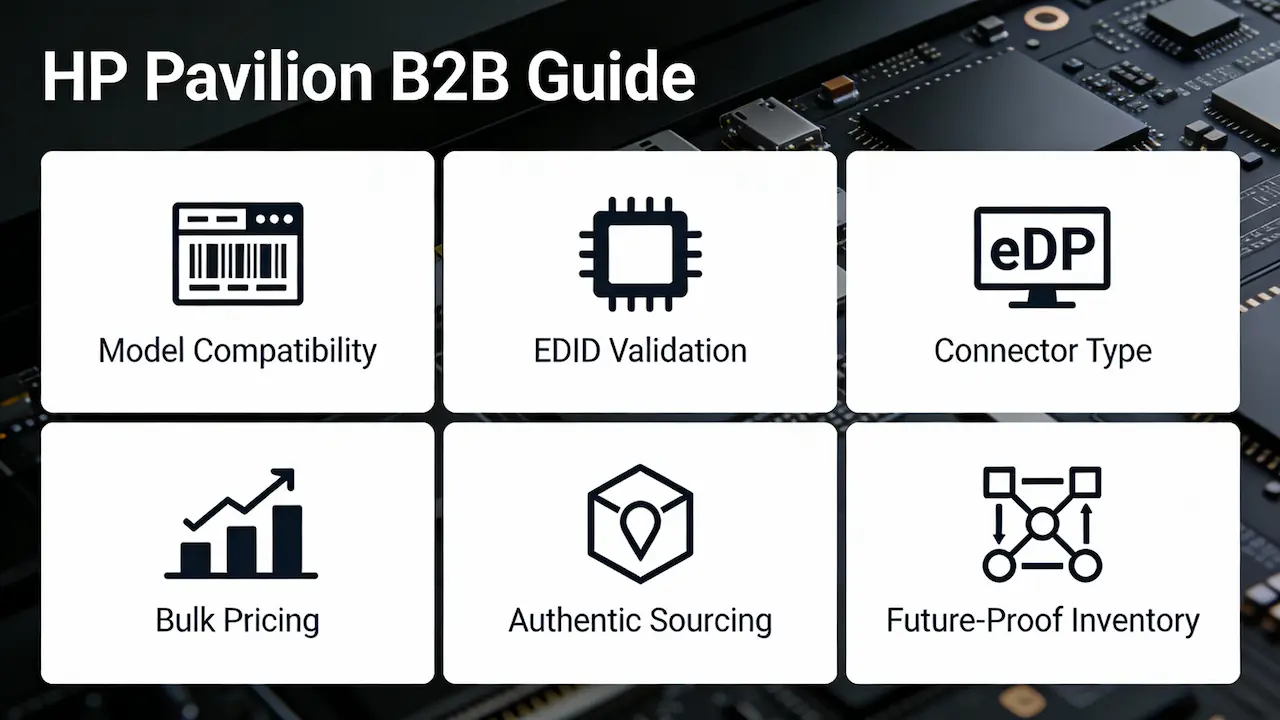
Not all “HP Pavilion 15” are equal. The critical identifier is the full service tag (e.g., 15-eg0023dx), not just screen size. Key compatibility layers include:
- Connector type: Most post-2015 models use 30-pin eDP, but DV4/DV6 (2009–2012) require 40-pin LVDS.
- Touch vs. non-touch: X360 and select G-series use integrated digitizers; swapping requires matching I²C controller IDs.
- Resolution & refresh: Gaming models (e.g., 15-cx0056wm) often ship with 144Hz IPS, while base models use 60Hz TN—swapping causes EDID handshake failure.
We maintain a live HP Pavilion Panel Cross-Reference Database (updated monthly) that maps each service tag to verified panel specs, including OEM part numbers and alternative suppliers. [Link to brand pillar page: HP Hewlett-Packard Laptop Screen Replacement Guide]
Technical Deep Dive: What Makes a Screen “Truly Compatible”?
True compatibility goes beyond physical fit. Three technical thresholds must align:
- EDID Signature: HP BIOS validates the Extended Display Identification Data. Mismatch = black screen after POST.
- Power Draw Tolerance: Panels drawing >0.5W over spec can trigger thermal throttling or shutdown (common with third-party replacements).
- eDP Lane Configuration: A 4-lane panel forced into a 2-lane motherboard results in flickering or no signal.
In one documented case, a distributor replaced an AUO B156HAN04.0 (4-lane) with an Innolux N156BGE-EA1 (2-lane) in a Pavilion Gaming 15—despite identical resolution and connector, the unit failed to display. Only after matching lane count did stability return.
Bulk Pricing Realities: What Distributors Actually Pay
Retail sites list 80–150 per screen—but B2B economics differ sharply:
| Order Volume | Avg. Unit Cost (FHD Non-Touch) | Avg. Unit Cost (FHD Touch) |
|---|---|---|
| 10–49 pcs | 22–28 | 35–42 |
| 50–199 pcs | 18–23 | 29–36 |
| 200+ pcs | 12–19 | 22–28 |
Source: Aggregated Q3 2025 quotes from 12 global distributors (ex-factory, FOB Hong Kong)
Note: Prices assume standard lead time (15–20 days). Rush orders (+30% premium) available for top-tier partners.
How to Source Authentically Without Overpaying
Avoid “OEM-compatible” traps. True factory-direct panels carry traceable lot codes and comply with ISO 13406-2 for luminance consistency (≥250 nits for Pavilion). We recommend:
- Verify panel origin: Request COO (Certificate of Origin) and batch test reports.
- Demand EDID validation: Reputable suppliers provide pre-flashed EDID dumps matching HP’s whitelist.
- Prioritize panel families: BOE NV156FHM-N4X and AUO B156HAN series cover ~68% of Pavilion FHD demand (2018–2023).
As an authorized channel partner for BOE, Innolux, and HKC, we pre-validate all stock against HP’s compatibility matrix—reducing your RMA rate by up to 41% (based on 2024 client data).
Building a Future-Proof Pavilion Inventory Strategy
Given HP’s panel diversification, holding single-SKU inventory is risky. Instead, adopt a modular stocking approach:
- Stock 3 core panel families (e.g., BOE NV156, AUO B156, Innolux N156) covering 80% of common models.
- Use dynamic bundling: Pair high-turnover screens (e.g., Pavilion 15-eg) with low-volume touch variants (e.g., x360) in mixed pallets to reduce MOQ pressure.
- Monitor end-of-life alerts: HP typically discontinues Pavilion sub-lines every 18 months—liquidate slow-movers before EOL announcements.
This strategy helped a Brazilian distributor cut dead stock by 33% while increasing fill rate to 94%.
FAQ
How much does it cost to replace an HP Pavilion screen for bulk orders?
For wholesale quantities (MOQ 10+), unit costs range from 12to25 for standard FHD non-touch panels, depending on volume and model specificity. Touchscreen and high-refresh variants start at $22. Contact us for a model-specific quote sheet.
Can I get OEM laptop screens for my business at a discounted rate? What's the MOQ?
Yes. As a direct channel partner of major panel makers (including BOE and AUO), we offer tiered wholesale pricing starting at 10 units per SKU. All panels include validated EDID and full technical documentation.
Where can I find suppliers of HP Pavilion screens for bulk purchasing?
Reliable sources include authorized panel distributors with HP compatibility validation protocols. We publish a quarterly “Verified Supplier List” as part of our comprehensive framework for global distributors.