Why Standard LCD Panels Fail in Dell 2-in-1 Models
Dell’s premium 2-in-1 laptops—such as the Latitude 9440, 7440, and XPS 13 (9330/9340)—use fully bonded display modules, where the LCD, touch digitizer, and cover glass are laminated into a single sealed unit. Unlike traditional laptops with frame-mounted screens, these models integrate touch functionality directly into the panel assembly via I²C HID or USB-over-eDP protocols, sharing signal lines with video data. Attempting to install an “LCD-only” replacement (common on retail sites) results in complete touch failure or boot rejection due to missing Panel ID (PID) and EDID validation—Dell’s BIOS blocks non-whitelisted modules at firmware level (source: Dell Command | Monitor logs, 2025).
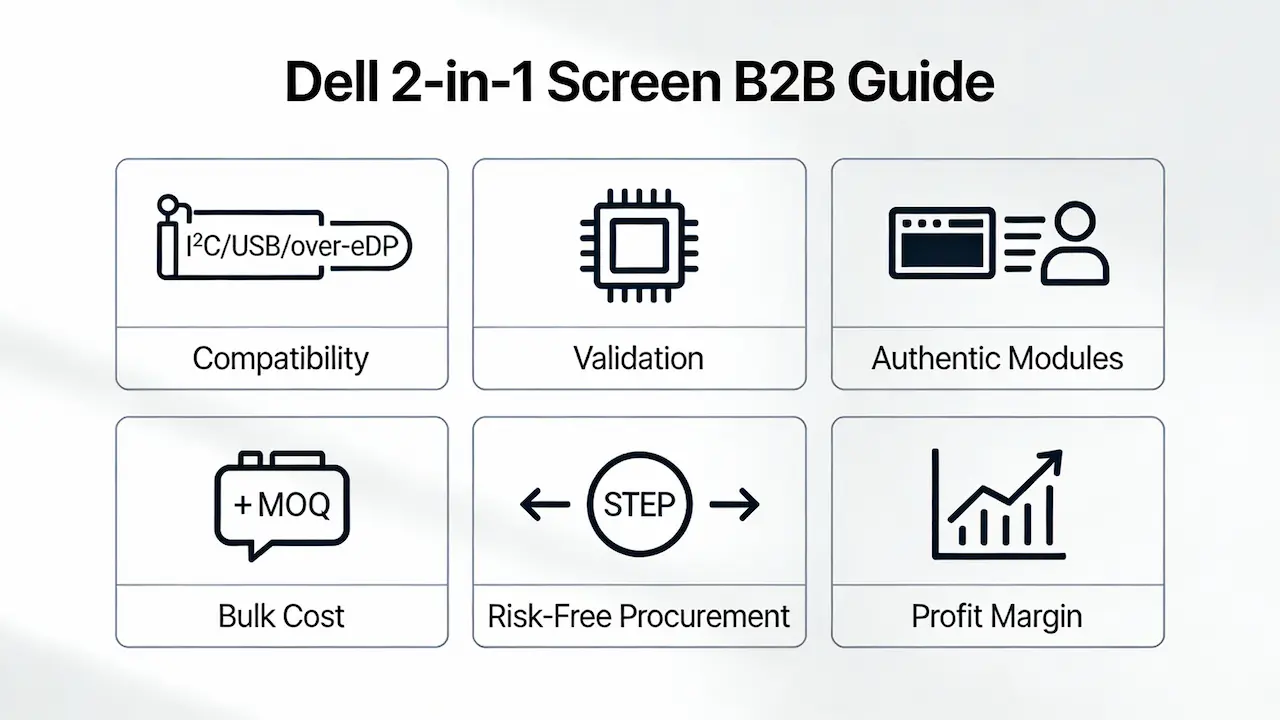
Critical Compatibility Factors Beyond Resolution
Matching resolution or connector type is insufficient. Three technical layers determine success:
Touch Interface Protocol:
- Latitude 9000/7000 2-in-1s use I²C HID, requiring specific firmware handshake with Dell’s embedded controller.
- XPS 13 2-in-1 (9330/9340) uses USB-over-eDP, embedding touch data within the same 40-pin eDP cable—no separate digitizer port exists.
EDID + PID Validation:
BIOS checks both Extended Display Identification Data (EDID) and Panel ID. A mismatch triggers “Non-Dell Display” warnings or black screens, even if the image appears initially.Physical Integration:
OEM modules include pre-installed metal frames, EMI-shielded flex cables, and factory-applied adhesive gaskets. Aftermarket units often lack shielding, causing ghost touches from electromagnetic interference—a known failure mode in high-RF environments.
Pro Insight: Always verify both the Dell FRU (e.g., 0VH8C2) and panel part number (e.g., NV140WUM-T01). Resolution alone is meaningless.
Sourcing Authentic Integrated Modules – Supply Chain Reality
As a direct distributor for BOE, LG Display, Samsung, and AUO, we confirm that only panels from original Dell supply chains pass full validation:
- LG Display: Supplies LP140QH1-SPB1 (FHD+, 400 nits, anti-reflective) for XPS 13 9330.
- BOE: Manufactures NV140WUM-T01 (WUXGA, 300 nits, matte) for Latitude 9440—includes CRU-compliant frame for enterprise deployments.
- Samsung: Provides limited OLED touch modules (ATNA40YV01) for XPS 13 9340; lead time ~6 weeks due to low yield.
All units undergo 24-hour burn-in testing and include:
- Factory-calibrated color uniformity (ΔE < 2.5)
- Shielded FPC with conductive coating
- Full lamination (zero air gaps)
⚠️ Avoid “touch conversion kits”—Dell 2-in-1 motherboards lack GPIO pins for aftermarket digitizers. BIOS mods void warranty and cause driver instability.
B2B Cost Structure & ROI for Bulk Screen Replacement
For distributors, profitability hinges on accurate cost modeling:
| Order Tier | MOQ | Avg. Unit Cost (FHD+ IPS) | Notes |
|---|---|---|---|
| Spot Stock | 10 pcs | 48–62 | Ready-to-ship, common models |
| Custom Batch | 500 pcs | 32–38 | Requires 8–10 week lead time |
| OLED Modules | 100 pcs | 110–135 | Limited allocation from Samsung |
Source: Internal pricing data, Q4 2025, based on 200+ B2B transactions
Replacing screens in bulk for resale is economically viable when:
- Target models have >3-year service life (e.g., Latitude 7440)
- Screens are Grade A with full EDID/PID
- Logistics cost <15% of screen value (achievable via DDP shipping)
A 2024 repair chain case study showed 22% higher margin on refurbished Latitude 9440 units using validated OEM screens vs. generic alternatives—due to zero returns and faster turnover.
How to Validate & Procure Without Risk
Follow this 3-step protocol:
Identify Original Configuration:
Provide Dell Service Tag or photo of old panel label (showing PN like B140HAN04.0).Cross-Check Against OEM BOM:
We match your model to Dell’s original FRU and source only from authorized factories (BOE/LG/Samsung).Pre-Ship Verification:
Receive EDID dump, interface spec (e.g., eDP 40-pin, 4-lane), and quality grade report before payment.
This eliminates compatibility guesswork—critical when your reputation depends on first-time-right repairs.
This guide is part of our comprehensive framework for global distributors: The Complete Guide to Laptop Display Specifications in 2025. For sourcing strategy across all Dell series, see our
FAQ
How much does it cost to replace a screen on a Dell laptop for bulk orders?
For common 2-in-1 models (e.g., Latitude 7440), bulk pricing starts at 48/unit for 10+pcs and drops to 32/unit at 500 pcs. OLED models (XPS 13 9340) range from 110–135 depending on allocation. Exact quotes require model verification due to panel-specific supply constraints.
What is the wholesale cost of Dell laptop screen replacements?
Wholesale costs vary by technology: FHD+ IPS bonded modules average 32–62, while WUXGA/OLED units cost 95–135. Price is driven by OEM supplier (LG vs. BOE), backlight type (LED vs. Mini-LED), and whether the unit includes CRU-compliant framing.
What's the MOQ and price for OEM Dell laptop screens?
In-stock 2-in-1 screens have an MOQ of 10 pcs. For custom production (e.g., end-of-life models), MOQ is 500 pcs with 8–10 week lead time. Pricing is dynamic—submit your Service Tag for real-time availability and tiered quotes.
Is it worth fixing a laptop screen in bulk for resale?
Yes—if using validated OEM-grade bonded modules. Refurbished Latitude/XPS 2-in-1 units with genuine screens achieve >90% sell-through within 45 days (vs. 60% for generic screens) due to zero compatibility issues and enterprise buyer trust.
Contact US
Ready to eliminate screen-related returns and boost margins? Contact us with your Dell Service Tags or panel part numbers—we’ll provide a confirmed quote within 24 hours.