Are you a distributor or repair shop owner searching for reliable sources of laptop chargers, only to be met with consumer-facing retail links? This guide is crafted specifically for you. We cut through the noise to provide a strategic framework for sourcing HP, Dell, and Lenovo laptop chargers in bulk—focusing on profitability, quality control, and supply chain stability, not single-unit purchases.
1.The Sourcing Crossroads: A Framework for Professional Procurement
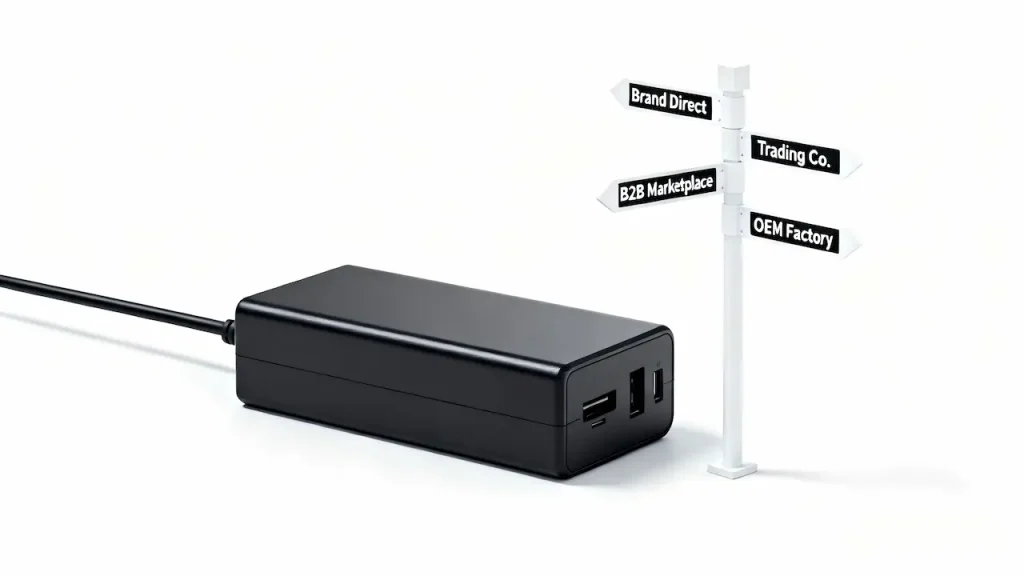
As a professional distributor or repair shop, your first search for “where to buy laptop chargers” likely leads you to a dead end of consumer retail sites. This is because the mainstream internet is optimized for B2C sales. The true B2B procurement landscape is more complex and requires a strategic framework to navigate successfully. Understanding the four primary pathways is the first critical step in making an informed, profitable decision for your business.
The core dilemma you face boils down to a choice between convenience and control, between markup and margin.Each pathway offers a different balance of these factors. We have deconstructed this landscape into four distinct models to provide you with a clear, objective analysis. This framework will empower you to evaluate your options not just on price, but on the critical metrics that drive long-term business success: supply chain stability, quality assurance, and operational efficiency.
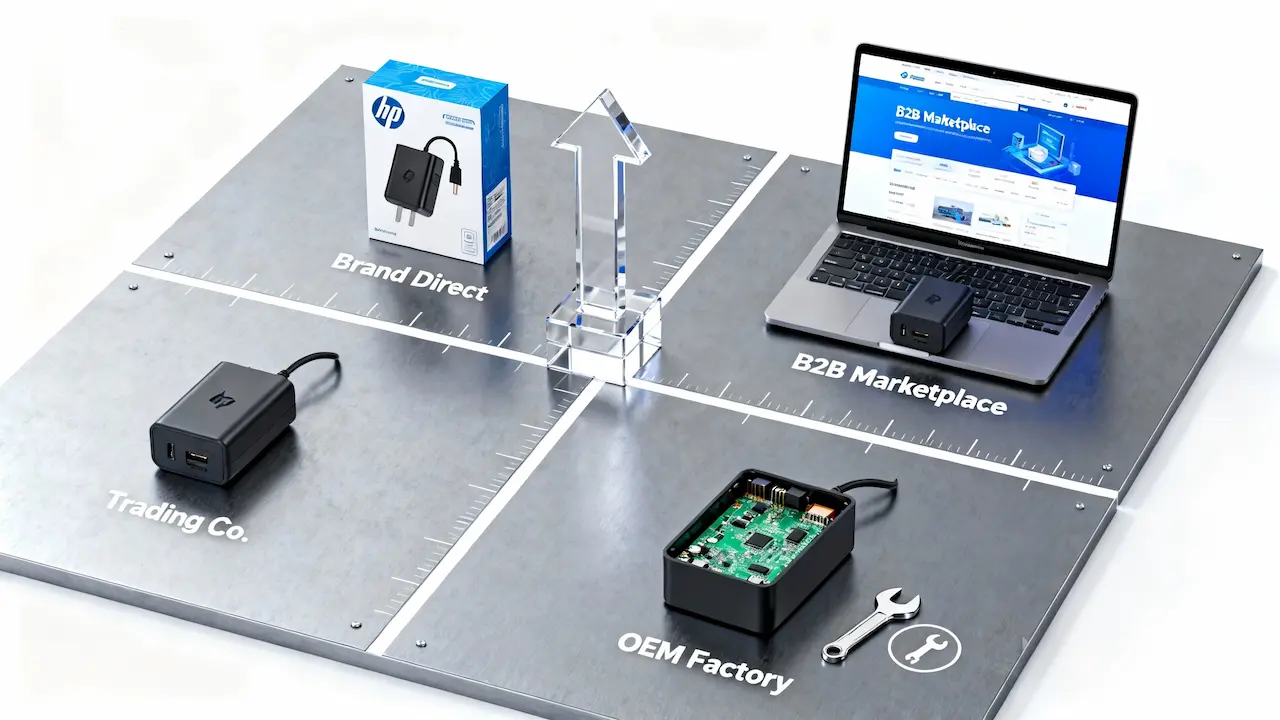
The following section will delve into the specifics of each model. But first, the visual framework below encapsulates the strategic choice at the heart of professional procurement.
Beyond Amazon and Best Buy: Why Consumer Channels Fail for B2B
When you type a broad query like “where to buy HP Dell Lenovo laptop charger,” search engines understandably return results for the largest audience: individual consumers. Platforms like Amazon, Best Buy, and Walmart dominate these results because they excel at serving that market. However, for a business like yours, relying on these channels is not just inefficient; it is a strategic misstep that directly undermines profitability and operational stability.
The core failure of consumer channels for B2B procurement lies in a fundamental mismatch of economic models. These platforms are built for single-unit, immediate-gratification purchases at retail prices. For a distributor or repair shop, this model is untenable. Purchasing chargers at a 100% markup eliminates your margin before you even begin. Furthermore, the logistical nightmare of managing dozens of separate retail orders to meet your inventory needs creates unnecessary complexity. There is no option for customization, such as specific cable lengths or your own branding (OEM/ODM), and you are treated as just another consumer, with no dedicated account management or volume-based support. In short, while consumer channels are a convenient solution for an end-user replacing a single charger, they represent a dead end for professional buyers seeking to build a scalable, profitable business.
1.2: The Four Procurement Pathways for Professional Buyers
To make a strategic sourcing decision, you must first understand the entire playing field. The B2B landscape for laptop chargers can be effectively categorized into four distinct pathways, each with its own operational and economic implications. The following framework will provide the foundation for our detailed analysis in the next section.
Brand-Owned Channels (OEM & Authorized Distributors):This pathway leads directly to the original equipment manufacturers (HP, Dell, Lenovo) or their authorized distributors. This source provides guaranteed authenticity but comes with a significant price premium and terms designed for end-users, not resellers.
Trading Companies / Middlemen:These are intermediaries who purchase from factories and resell to you. They often offer ease of communication and low minimum order quantities (MOQs), but they add a layer of cost and may have limited control over quality and production.
Online B2B Marketplaces (e.g., Alibaba, Global Sources):These platforms connect buyers with a vast array of suppliers, primarily factories and traders. They offer immense choice but require significant due diligence to navigate quality inconsistencies and verify supplier claims effectively.
Direct Sourcing from OEM Factories (The Strategic Choice):This pathway involves building a direct relationship with a manufacturer like us, who designs and produces the chargers. This model offers the most control over cost, quality, and customization, and is the foundation for a stable, long-term supply chain. It is the focus of this guide and the choice of sophisticated distributors aiming for a competitive edge.
Understanding these four pathways is crucial. The following section will deconstruct each one, providing a clear, objective analysis of their advantages and critical drawbacks for a professional procurement strategy.
Need Model-Level Clarity? Access Our Brand-Specific B2B Guides
While this guide outlines the strategic framework for sourcing, successful procurement also demands technical precision. For model-by-model compatibility, pinout diagrams, obsolescence alerts, and bulk-sourcing tips, refer to our dedicated OEM charger guides:
- HP Laptop Charger Guide: EliteBook, Pavilion & Spectre x360 Compatibility
- Dell OEM Charger Procurement Guide: Latitude, XPS & Precision Series
- Lenovo OEM Charger Compatibility Matrix: ThinkPad, IdeaPad & Yoga Models
- ASUS Charger Technical Guide for B2B Buyers
- Samsung Laptop Charger Sourcing Guide for Dealers
These resources bridge the gap between procurement strategy and technical execution—ensuring you never ship the wrong adapter again.
2.Deconstructing the Sourcing Matrix: An Objective Analysis of Your Choices
Now that we have defined the four primary procurement pathways, it is time to dissect each one. An informed decision requires a clear-eyed view of the trade-offs involved. This objective analysis moves beyond surface-level features to examine the core operational, financial, and strategic implications of each model for your business. We will evaluate them based on key criteria that matter to distributors: cost structure, quality control, supply chain stability, and strategic flexibility.
The goal is not to simply label one option as “good” and another as “bad,” but to provide you with a factual framework that aligns with your specific business objectives. Whether your priority is absolute lowest cost, risk mitigation, or long-term partnership, understanding these nuances is critical. The following breakdown will empower you to choose the pathway that best supports your growth and protects your brand reputation.
2.1: Brand-Owned Channels: Guaranteed Authenticity at a Premium
When sourcing HP, Dell, or Lenovo laptop chargers, the most straightforward path might seem to be going directly to the source: the brand’s own official sales channels or their network of authorized distributors. This pathway offers the undeniable advantage of 100% guaranteed authenticity. You receive a product with perfect compatibility, full manufacturer warranty, and the peace of mind that comes with genuine components. For mission-critical environments where absolute certainty is required, this can be a valid choice.
However, for a distributor or repair business focused on profitability and scalability, this model is fundamentally misaligned with your core objectives. The primary drawback is prohibitive cost. Brand-owned channels operate on a pricing structure designed for end-user retail, not B2B wholesale. The margin built into these prices leaves virtually no room for you to resell the product competitively while maintaining a sustainable profit.
Beyond cost, the strategic limitationsare severe. The procurement process is often rigid and designed for single-unit or small-quantity purchases, not the bulk orders that form the backbone of your inventory. Most critically, there is zero flexibility for customization (OEM/ODM). You cannot request different cable lengths, custom connectors, or your own branding—elements that could differentiate your service in the marketplace. You are purchasing a standardized retail product, not developing a strategic supply partnership.
In summary, while brand-owned channels guarantee product authenticity, they do so at the expense of your profitability, operational flexibility, and strategic growth. They are designed to serve the end-consumer, not to empower a reseller or repair business.This makes them an unsuitable primary source for professional B2B procurement. The following analysis will reveal more viable alternatives that balance quality with commercial sense.
2.2: Trading Companies & Middlemen: Flexibility with Hidden Costs
Trading companies and middlemen position themselves as the agile alternative to navigating complex global supply chains. They offer apparent advantages that can be initially appealing: low minimum order quantities (MOQs), easier communicationin your native language, and consolidated shipmentsfrom various suppliers. This model provides a perceived layer of insulation from the challenges of direct factory engagement.
Beneath this surface-level convenience, however, lie significant compromises that directly impact your business’s bottom line and risk profile. The most fundamental issue is the added cost layer. Every middleman inserts their own margin into the price, making it impossible for you to access true factory-direct pricing. While the per-unit cost may seem lower than brand-owned channels, it is inherently higher than what a direct factory relationship would yield.
Furthermore, this model introduces critical opacity and diluted control. You are disconnected from the actual production source, relying entirely on the middleman’s claims about quality standards, materials, and manufacturing processes. This lack of transparency increases risk, as any quality issue or supply chain disruption must be resolved through an intermediary who has limited direct control over production. You sacrifice supply chain visibility for short-term convenience.
In essence, trading companies offer a service of intermediation, but this service comes at a steep price—both financially and strategically.They may serve as a stepping stone for very small-scale entrants, but for any business serious about building a competitive, scalable, and cost-effective supply chain, they represent an unsustainable long-term solution. The following section will explore a pathway that eliminates these middlemen and their associated costs.
2.3: Direct from OEM Factory: The Strategic Choice for Scalable Growth
Sourcing directly from an OEM (Original Equipment Manufacturer) factory represents the most strategically advantageous pathway for professional distributors and repair businesses. This model transcends simple transactional purchasing to establish a true partnership-based supply chain. By eliminating all intermediaries, you gain unprecedented control over the three most critical factors for scalable growth: cost, quality, and customization.
The most immediate benefit is optimal pricing structure. Without multiple layers of markups, you access true factory-direct prices. This fundamental advantage creates the healthy margin space necessary to compete aggressively in the market while maintaining sustainable profitability. Furthermore, this direct relationship provides complete transparency and control over quality. You can specify exact materials, require rigorous testing protocols, and even conduct factory audits to ensure every product meets your precise standards.Explore our full catalog of certified OEM laptop power adapters—covering HP, Dell, Lenovo, and more—with options for custom wattage, connector types, and private labeling.
Most importantly, the OEM model unlocks strategic customization (OEM/ODM). This is where your business can truly differentiate itself. You are no longer limited to generic, off-the-shelf products. Instead, you can develop customized solutions—specific cable lengths, unique connector types, specialized power ratings, or your own branded packaging—that perfectly address your customers’ needs and build your brand identity.
In summary, while establishing a direct OEM relationship requires more initial due diligence and communication, it is the only procurement model designed specifically for scalable B2B growth.It transforms your supply chain from a cost center into a competitive advantage, providing the foundation for long-term market leadership.
3.Making the Strategic Leap: From Sourcing to Partnership
3.1 Ready to Transform Your Supply Chain?
The analysis of the four procurement pathways reveals a clear conclusion: the future of competitive, scalable distribution belongs to those who control their supply chain at its source. Relying on consumer channels, brand markups, or intermediary traders inherently limits your growth potential and exposes your business to unnecessary risk and inefficiency. The strategic shift to a direct OEM partnership is not merely a purchasing decision; it is an investment in the foundational stability and profitability of your enterprise.
This transformation moves you from being a passive buyer in a crowded market to an active architect of your product offerings. It is the difference between selling generic commodities and providing tailored solutions. By internalizing the insights from this guide, you are now equipped to make an informed choice that aligns with long-term business success, not just short-term convenience. The final step is to translate this knowledge into action.
3.2 Your Low-Risk Next Steps with [SUP]
Making the strategic decision to partner with an OEM factory is the first step. Taking the next step with [SUP] is designed to be a seamless, no-obligation process that provides immediate value and clarity. We have structured our engagement to minimize your risk while maximizing the actionable information you receive, allowing you to make a final decision with complete confidence.
Schedule a 15-Minute Consultation with Our Sourcing Expert
Begin with a focused, 15-minute conversation with one of our senior sourcing consultants. This is not a sales pitch, but a dedicated session to analyze your specific business needs, target market, and product requirements. We will provide preliminary insights on optimal product specifications, potential cost-saving opportunities, and a high-level roadmap for your supply chain transformation. This conversation is your opportunity to assess our expertise and get tailored advice at no cost.
Contact Us Today to Request Free Samples and a Competitive Bulk Quotation
Experience the [SUP] difference firsthand. We invite you to request complimentary samples of the specific laptop charger models relevant to your business. Evaluate our build quality, performance, and compatibility directly alongside your current suppliers. Concurrently, we will prepare a detailed, competitive bulk quotation based on your volume, providing full transparency into the pricing advantage a direct OEM partnership offers. This two-pronged approach—tangible product validation and clear financial data—equips you with everything needed to make an informed, low-risk decision for your business.