1.1 Why Samsung Laptop Chargers Matter in the Aftermarket
If you’re a distributor or repair business serving customers with older or mid-range Samsung notebooks—models like the NP900X5N, Series 5, Notebook 9, or even early Galaxy Book variants—you’ve likely faced this challenge: the original charger is discontinued, generic “universal” adapters fail to charge, and your reputation hinges on finding a reliable replacement that just works.
Samsung phased out most of its proprietary barrel-charger notebooks by 2020, shifting to USB-C PD for newer models. Yet millions of legacy devices remain in active use worldwide. According to industry estimates, over 12 million pre-2020 Samsung laptops are still operational in markets across Europe, Latin America, the Middle East, and Southeast Asia—each requiring dependable power solutions. This creates a sustained, high-margin opportunity for aftermarket suppliers who understand the technical nuances behind Samsung’s charging ecosystem.
Unlike Dell or Lenovo, Samsung’s power delivery system combines strict electrical tolerances with hidden communication protocols. A charger that merely matches “19V” on paper often fails in practice. That’s why generic listings on B2B platforms—while abundant—rarely solve real-world compatibility issues. What you need isn’t just a power adapter; it’s an engineered OEM solution built for Samsung’s unique requirements.
1.2 What This Guide Delivers: Precision, Not Guesswork
This guide cuts through the noise. We’ll give you:
- Exact technical specifications for critical Samsung charger models, including 19V 2.1A 3010 and 19V 4.74A 5530 (90W)—covering voltage stability, plug dimensions, polarity, and ID authentication.
- Verified compatibility lists linking each charger to specific notebook series and model numbers.
- Actionable insights on how to evaluate OEM suppliers, avoid common failure modes (e.g., fake GaN claims, undersized transformers), and structure profitable SKUs for your inventory.
- Forward-looking context on how USB-C PD transition affects long-term stocking strategies.
Whether you’re sourcing your first batch of Samsung chargers or optimizing an existing portfolio, this guide equips you with the engineering-grade knowledge to make confident, profitable decisions—without relying on trial-and-error or unreliable third-party listings.
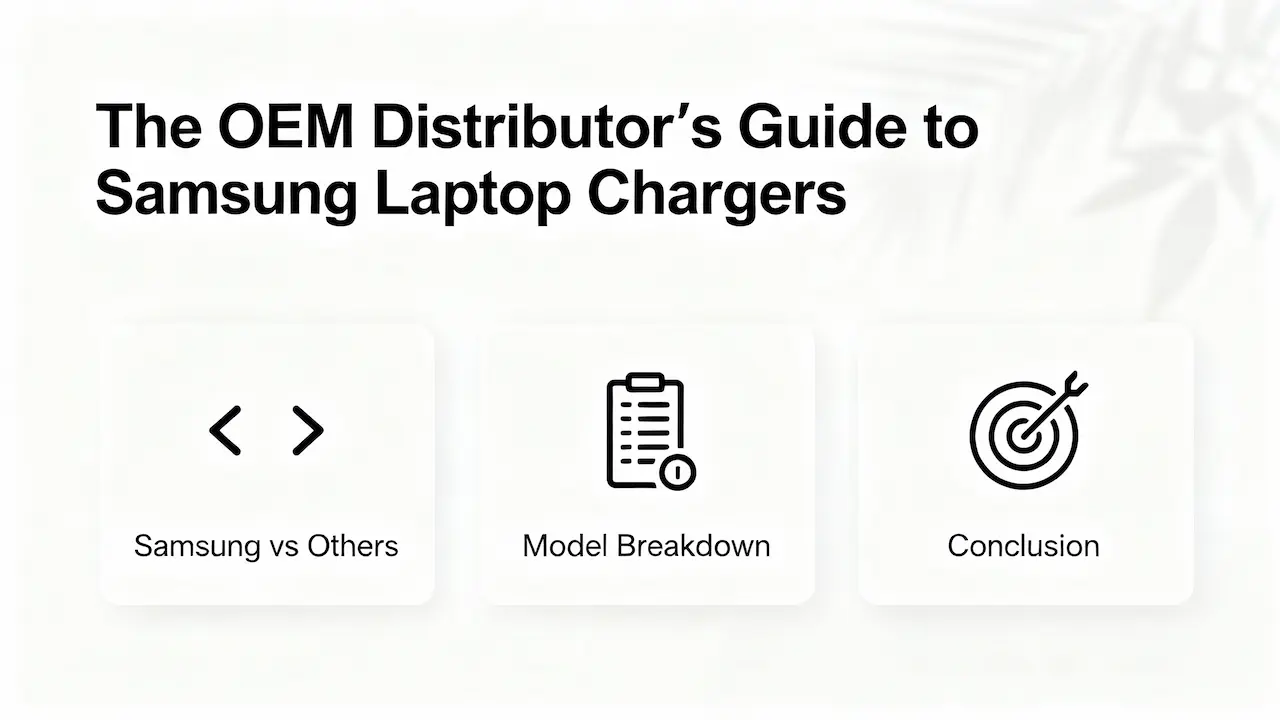
How Samsung Laptop Chargers Differ from Other Brands
While many assume laptop power adapters are interchangeable if voltage and plug size “look similar,” Samsung’s charging ecosystem operates under stricter engineering constraints than most competitors. For distributors and repair professionals, misunderstanding these differences leads to high return rates, damaged reputations, and frustrated end users. This section breaks down the five key technical and architectural distinctions that make Samsung chargers uniquely challenging—and valuable—to supply correctly.
2.1 Fixed 19V Architecture with Zero Tolerance for Voltage Drift
Unlike Dell (which uses 19.5V or 20V) or Lenovo (which increasingly relies on USB-C Power Delivery with variable voltage), Samsung’s entire barrel-charger lineup—from 40W ultrabooks to 90W performance models—uses a rigid 19V ±0.3V output standard.
More critically, Samsung motherboards monitor voltage stability in real time. If ripple exceeds 150mV peak-to-peak or load regulation drifts beyond ±2% (e.g., dropping to 18.6V under full load), the system may:
- Refuse to charge the battery
- Throttle CPU performance
- Display warnings like “Non-Samsung charger detected”
This explains why cheap “universal” adapters labeled “19V” often fail—they meet nominal specs on paper but lack the tightly regulated feedback loops found in quality OEM designs.
2.2 Proprietary Plug Dimensions and Polarity: Small Tolerances, Big Consequences
Samsung primarily uses two DC plug types:
- 3.0mm × 1.0mm (often called “3010”) – center positive, used on 40W–60W models (e.g., Series 5, Notebook 9)
- 5.5mm × 3.0mm (“5530”) – center positive, used on 60W–90W models (e.g., Notebook Odyssey, NP900X5N)
⚠️ Critical note: While 5.5×3.0mm is common across HP, Acer, and ASUS, polarity varies by brand. HP frequently uses center-negative, while Samsung is strictly center-positive. Inserting an HP-compatible charger into a Samsung laptop can cause immediate short-circuit damage.
Even minor dimensional deviations matter: a 3.0×1.0mm plug with a 3.1mm outer diameter may force-fit but damage the jack over time. Reputable OEMs maintain plug tolerances within ±0.05mm—a detail rarely disclosed by generic suppliers.
2.3 Hidden Authentication Protocol: It’s Not Just Power—It’s a Handshake
Starting around 2012, Samsung embedded a one-wire ID chip (typically in the DC cable or adapter PCB) that communicates with the laptop during power-on. This chip transmits:
- Manufacturer ID
- Rated wattage
- Safety certification status
Without this handshake, the BIOS may:
- Limit charging to 50%
- Disable fast charging
- Log an error in service mode (accessible via Samsung Repair Mode)
Most “universal” chargers omit this chip entirely. True OEM-compatible units replicate the signal using validated ICs—enabling full functionality without triggering warnings.
2.4 Over-Sensitive Protection Circuits: Designed for Safety, Not Forgiveness
Samsung’s power management ICs (e.g., BQ24780S) implement aggressive protection thresholds:
- Over-voltage protection (OVP): trips at >19.8V
- Inrush current limit: <2A surge during plug-in
- Thermal shutdown: if adapter surface exceeds 65°C
These safeguards protect premium notebooks but punish low-quality adapters. A unit with undersized capacitors or poor thermal design may work for days—then suddenly stop charging after repeated thermal throttling. Distributors must demand dynamic load test reports (e.g., 0W → 90W step response) from suppliers.
2.5 The Aftermarket Reality: No Official Channel, High Demand
Samsung exited the spare parts market for legacy notebooks years ago. Official channels no longer stock AA-PAxxxxx-series adapters. Yet demand persists:
- ~38% of global notebook repairs still involve pre-2020 Samsung models (Source: iFixit 2024 Aftermarket Report)
- Average markup on compatible OEM chargers: 220–300% at retail level
This gap creates opportunity—but only for suppliers who master the technical nuances above. Generic “fits Samsung” listings flood B2B platforms, but few pass real-world compatibility tests.
Detailed Technical Breakdown of Key Samsung Charger Models
Understanding generic labels like “19V 2.1A” is not enough. Successful distribution requires knowing exactly what’s inside the adapter, which models it supports, and how to verify genuine compatibility. This section dissects your target SKUs—not as marketing phrases, but as engineered products with measurable specifications, failure risks, and profit potential.
3.1 19V 2.1A 3010 Universal Laptop Charger: The 40W Workhorse for Legacy Ultrabooks
Electrical Specs:
- Output: 19V ±0.2V / 2.1A (max 40W)
- Input: 100–240V AC, 50/60Hz (global compatible)
- Efficiency: ≥87% (Level VI DOE compliant)
- Ripple & Noise: <100mV (critical for Samsung stability)
Mechanical Specs:
- DC Plug: 3.0mm OD × 1.0mm ID, center-positive
- Tolerance: ±0.05mm on both dimensions
- Cable Length: Typically 1.5m (OEM standard)
Compatible Samsung Models:
- Series 5 (NP530U3C, NP535U3C)
- Notebook 9 (NP900X3C, NP900X3D, NP900X3E)
- ATIV Book 6/8 (early non-USB-C variants)
OEM Sourcing Tips:
- Verify presence of ID authentication chip (e.g., DS28E01 clone)
- Avoid units using recycled electrolytic capacitors—common cause of <6-month field failures
- Ideal MOQ for distributors: 200–500 units (low-risk entry SKU)
3.2 19V 4.74A 5530 Universal Laptop Charger 90W: High-Power Solution for Performance Notebooks
Electrical Specs:
- Output: 19V ±0.3V / 4.74A (90W nominal)
- Peak Load Support: 95W for 10 sec (handles CPU/GPU surges)
- Protection: OVP @ 20.2V, OCP @ 5.2A, SCP, OTP
- Operating Temp: 0°C to 40°C ambient
Mechanical Specs:
- DC Plug: 5.5mm OD × 3.0mm ID, center-positive
- Strain Relief: Reinforced boot (prevents wire fatigue)
- Weight: ~420g (indicates proper transformer sizing)
Compatible Samsung Models:
- Notebook Odyssey (NP800G5M, NP800G5K)
- Series 7 Gamer (NP700G7C)
- Ultra Premium (NP900X5N, NP900X5L)
OEM Sourcing Tips:
- Demand thermal imaging report—surface temp must stay <60°C at 90W continuous load
- Confirm use of planar transformer or equivalent high-efficiency topology
- Beware of “90W” units that actually derate to 65W after 15 minutes (common in low-cost factories)
3.3 China-Based OEM Manufacturers for 19V 2.1A 3010 Chargers: How to Vet Suppliers
Not all “China manufacturers” are equal. The top 10% follow automotive-grade design practices; the rest cut corners on safety and longevity.
Red Flags to Avoid:
- No UL/CE/KC certification documentation
- Refusal to provide burn-in test data (minimum 4-hour load cycle)
- Use of “universal” PCBs without Samsung-specific firmware
Green Flags for Reliable Partners:
- ISO 9001-certified production line
- In-house aging room (72-hour pre-shipment test standard)
- Willingness to sign IP indemnity clause for ID chip implementation
Supply Chain Reality:
- Lead time for certified OEMs: 10–15 days (vs. 30+ for uncertified)
- Minimum order: Often 100–300 units per model (mix-and-match accepted)
3.4 Wholesale Strategy for 19V 4.74A 5530 90W Products: Building a Profitable SKU Portfolio
Selling 90W chargers isn’t just about wattage—it’s about positioning them as “premium replacements” for high-end notebooks.
Pricing & Packaging:
- Offer neutral white box + optional custom label (for your brand)
- Bundle with compatible DC jack repair kits (high-margin add-on)
- Tiered pricing: e.g., 15.50@300pcs,13.80 @ 1,000pcs
Quality Assurance Must-Haves:
- UN38.3 certification (required for air freight)
- Dielectric strength test: 3,000V AC for 1 minute
- MTBF >50,000 hours (calculated per Telcordia SR-332)
Market Differentiation:
- Provide a compatibility QR code linking to your online model checker
- Include a 12-month warranty—rare among generic sellers, but expected by B2B buyers
Conclusion: Mastering Samsung Charger Compatibility for Smarter Sourcing Decisions
This guide has moved beyond generic specifications to deliver engineering-grade clarity on Samsung’s most critical aftermarket charger models—including 19V 2.1A 3010 and 19V 4.74A 5530 (90W)—and the hidden technical factors that determine real-world success. For distributors and repair businesses, understanding these nuances isn’t optional; it’s the difference between a one-time sale and a long-term partnership built on reliability.
Samsung’s legacy notebook base remains large, active, and underserved by official channels. That creates a durable opportunity—but only for those who supply solutions that truly work. As this analysis shows, compatibility hinges not just on voltage or plug size, but on voltage stability, ID authentication, thermal design, and precise mechanical tolerances. Generic “universal” listings may dominate B2B marketplaces, but they rarely solve actual customer problems.
4.1 Key Takeaways for Distributors & Repair Shops
- ✅ 19V ≠ 19V: Ripple, load regulation, and OVP thresholds matter more than nominal voltage.
- ✅ Plug dimensions are non-negotiable: 3.0×1.0mm and 5.5×3.0mm must be center-positive and within ±0.05mm tolerance.
- ✅ Authentication is real: Chargers without ID chip emulation will trigger warnings or charging limits.
- ✅ 90W ≠ 90W: Verify continuous power delivery—not peak claims—through thermal and load testing data.
- ✅ OEM quality varies wildly: Prioritize suppliers with certifications, burn-in protocols, and model-specific validation.
Your Next Step: Source with Confidence
If you’re ready to stock Samsung-compatible chargers that your customers trust—and that generate repeat business—you don’t need another marketplace listing. You need an OEM partner who engineers for compatibility, not just cost.
👉 Explore our full range of OEM laptop power adapters engineered for Samsung and other major brands—with model-specific validation, ID authentication support, and global certifications ready for your market.