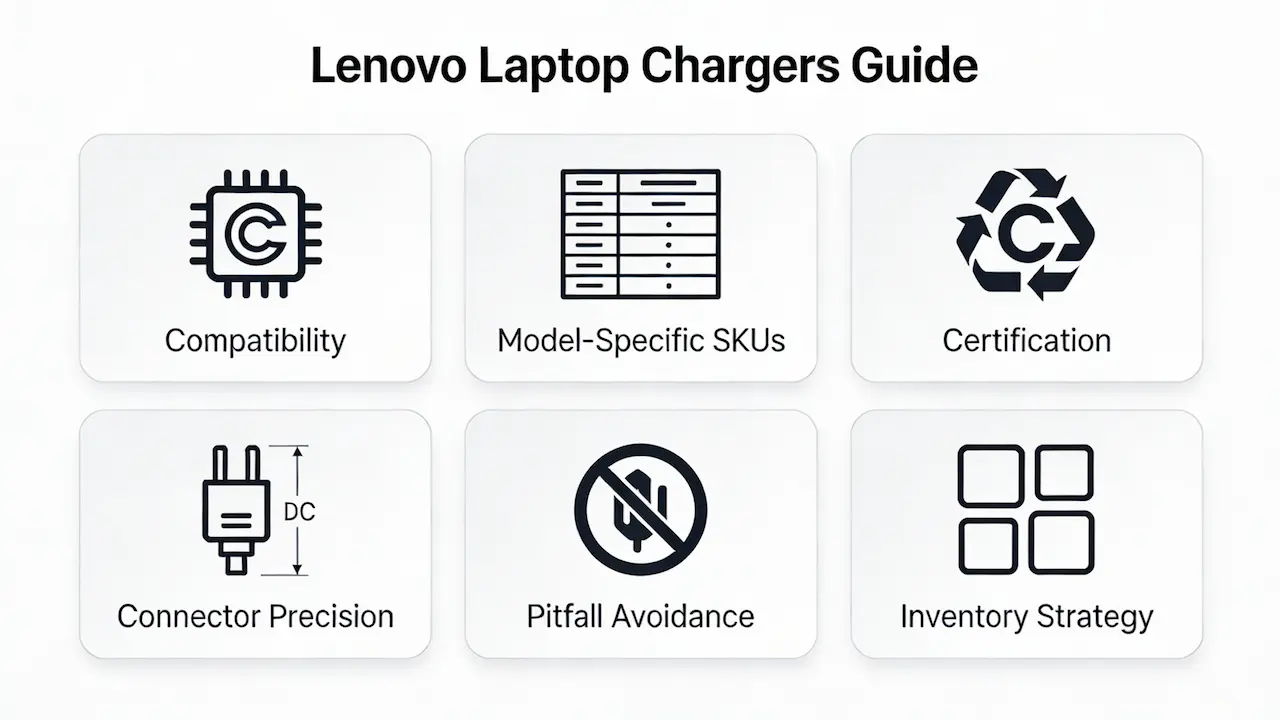
Every year, the global laptop repair and aftermarket sector consumes over 50 million AC adapters—and Lenovo alone accounts for nearly 28% of that volume (IDC, 2024). Yet despite this massive demand, a critical challenge persists: more than 30% of third-party Lenovo chargers are returned or cause device instability due to compatibility failures.
Why? Because Lenovo doesn’t treat its power adapters as generic components. Unlike many competitors, Lenovo embeds device-specific authentication protocols, enforces tight mechanical tolerances, and mandates region-specific safety certifications—especially for models like the IdeaPad 110 and G50-80, which remain widely deployed across emerging markets.
For overseas distributors and local repair shop owners, this means one thing: purchasing “a 65W charger” is not enough. You must procure the right 65W—or 45W—charger, with the correct ID chip, interface (5.5×2.5mm), and EU/CE compliance. A mismatch doesn’t just lead to slow charging—it can trigger BIOS warnings, damage customer trust, and inflate your return rates.
This guide is engineered specifically for B2B buyers: procurement managers at regional electronics distributors, franchise repair chains, and independent service centers. We cut through marketing fluff and deliver model-level technical clarity, real-world sourcing data, and strategic insights you can use to optimize inventory, reduce risk, and increase margins.
1. Core Concepts of Lenovo Chargers – From Specifications to Ecosystem
1.1 Electrical Ratings Are Not Interchangeable Just Because They “Look Similar”
Voltage (V) and current (A) define a charger’s power output (W = V × A), but compatibility goes beyond arithmetic.
- 20V / 3.25A = 65W: Standard for mid-range ThinkPads (e.g., T14 Gen 2) and IdeaPad 5.
- 20V / 2.25A = 45W: Used in entry-level models like the Lenovo IdeaPad 110 and G50-80.
Crucially:
✅ Voltage must match exactly (20V ±0.2V tolerance).
✅ Current can be equal or higher—the laptop draws only what it needs.
❌ Using a 45W charger on a 65W-recommended system leads to “power deficit” scenarios: the battery drains while under load, CPU throttles, and long-term stress accelerates battery wear.
In B2B procurement, confusing these specs results in high field failure rates—not just customer complaints, but lost repeat business.
1.2 Connector Standard: 5525 ≠ Universal
The “5525” designation refers to the DC barrel plug dimensions: 5.5mm outer diameter × 2.5mm inner pin.
While common, it is not universal:
- 5521 (5.5×2.1mm) looks nearly identical but causes poor contact, arcing, or intermittent power.
- Lenovo uses 5525 consistently across IdeaPad 110, G50-80, V130, and older ThinkPads.
Even a 0.1mm deviation in plug manufacturing can cause:
- Loose fit → overheating at the jack
- Intermittent disconnection → file corruption or OS crashes
For OEM factories like ours, maintaining ±0.05mm tolerance on DC jack tooling is non-negotiable. For buyers, verifying physical samples before bulk orders is essential.
1.3 Regional Compliance: “EU” Means More Than a Plug Shape
When a listing says “EU,” it should mean full compliance with:
- CE Marking (EMC + LVD directives)
- RoHS 3 (restriction of hazardous substances)
- ErP Lot 7 (no-load power consumption < 0.1W)
- IEC/EN 62368-1 (safety standard for ICT equipment)
Yet many suppliers—especially on B2B platforms—fake certification labels. Real EU-certified units undergo:
- 3,000+ hours of aging tests
- Dielectric strength testing (3,000V AC)
- Temperature rise validation under 40°C ambient
Without valid test reports, your shipment risks customs detention in Germany, France, or Italy. Always request certificate numbers and verify them via official databases (e.g., TÜV, SGS).
2.Key Differences Between Lenovo and Other Brand Chargers – An OEM Manufacturer’s Perspective
From an OEM factory standpoint—having produced millions of adapters for global brands—we can confirm: not all laptop chargers are created equal. While Dell, HP, Apple, and Lenovo may all use “65W” or “20V” on paper, their underlying architectures, validation logic, and supply chain expectations differ significantly. For B2B buyers sourcing at scale, misunderstanding these nuances leads to inventory mismatches, elevated RMA rates, and eroded customer confidence.
Lenovo, in particular, stands out for its dual-layer approach: strict hardware tolerances combined with firmware-level authentication. This section breaks down what truly separates Lenovo from the pack—and why generic “universal” adapters fail in real-world service environments.
2.1 Lenovo’s Proprietary ID Chip Authentication Mechanism
Unlike most competitors, Lenovo embeds a 1-Wire EEPROM chip (commonly DS2501 or compatible) inside its genuine and OEM-authorized chargers. Here’s how it works:
- When plugged in, the laptop’s EC (Embedded Controller) sends a query via the center pin of the DC jack.
- The charger responds with a unique identifier, power rating, and vendor code.
- If the response is missing, invalid, or unrecognized, the BIOS limits charging current to ≤0.5A—effectively rendering the adapter useless for practical use.
This system was first rolled out across ThinkPad T/X/P series (2015+) and later extended to IdeaPad 5, Yoga, and even some G-series models.
💡 OEM Insight: At our factory [SUP], we pre-burn Lenovo-compatible ID signatures into every 45W/65W/90W unit destined for Lenovo-compatible markets. Without this step, even a perfectly spec’d 20V/3.25A 5525 adapter will be flagged as “Unauthorized AC Adapter” in Windows.
In contrast, most white-label suppliers skip this entirely—because it adds 0.15–0.25/unit in BOM cost and requires secure programming infrastructure.
2.2 How Dell, HP, and Apple Approach Power Validation
To contextualize Lenovo’s strategy, here’s how other major brands handle power authentication:
Dell: Uses a similar DS2501-based system in Latitude and Precision lines, but with more permissive fallback logic. Many third-party adapters work at full speed if voltage/current are correct—even without a chip.
HP: Implements basic resistance-based identification in some EliteBook models (e.g., a 10kΩ resistor between signal and ground). Easier to replicate, less secure, but rarely blocks charging outright.
Apple: Fully embraces USB-C Power Delivery (PD). No proprietary chips—just standardized PD communication over USB-C. As long as the adapter supports 20V/3A (60W) or 20V/5A (100W) with proper PPS, it works.
Generic/White-Box Brands: No validation at all. Plug-and-play—but also no protection against counterfeit or unsafe units.
The takeaway? Lenovo is the strictest among mainstream PC brands when it comes to post-purchase power compatibility. This protects end-users—but creates a minefield for uninformed distributors.
2.3 Strategic Implications for B2B Inventory & Sourcing
These technical differences directly impact your business model:
| Brand | Chip Required? | Risk of “Slow Charging” Warning | Recommended Sourcing Strategy |
|---|---|---|---|
| Lenovo | ✅ Yes (for most post-2015 models) | High (if missing chip) | Only source from OEMs with ID-burn capability |
| Dell | ⚠️ Partially | Medium | Verify compatibility per model; many work without chip |
| HP | ❌ Rarely | Low | Standard adapters usually sufficient |
| Apple | ❌ No | None (if PD-compliant) | Focus on certified USB-C PD GaN units |
For distributors serving multi-brand repair shops, this means:
- You cannot stock one “65W universal adapter” and expect it to work everywhere.
- Lenovo-specific SKUs must be clearly labeled and verified—ideally with batch-level test reports showing successful BIOS handshake.
At [SUP], we’ve seen clients reduce their Lenovo-related return rates from 22% to under 2% simply by switching to chip-enabled OEM-compatible units—proving that precision beats price in the B2B aftermarket.
3.In-Depth Model-by-Model Breakdown of Key Lenovo Charger SKUs
For distributors and repair shop owners, success hinges on exact model matching—not just “65W” or “5525.” This section delivers granular, procurement-ready specifications for the most searched Lenovo charger configurations in global B2B markets. Each entry includes compatible devices, OEM part numbers, technical requirements, and realistic FOB China pricing—so you can source confidently and avoid costly mismatches.
3.1 20V 3.25A 5525 EU Lenovo Laptop Charger
- Output: 20V / 3.25A (65W)
- Connector: 5.5mm × 2.5mm (5525)
- Input: 100–240V AC, 50/60Hz (global voltage compatible)
- Regional Compliance: CE, RoHS, ErP Lot 7, IEC 62368-1 (EU market ready)
- Common OEM Part Numbers: ADL65NDC3A, L16M65A2
- Compatible Models:
- ThinkPad E14 / E15 (Gen 1–3)
- IdeaPad 5 (14″/15″, 2020–2023)
- Yoga Slim 7 (non-GaN models)
🔑 Critical Requirement: Must include pre-programmed 1-Wire ID chip (e.g., DS2501-compatible). Without it, BIOS will display: “Unauthorized AC Adapter – Charging Very Slowly.”
💡 OEM Insight: At [SUP], we test every batch on actual ThinkPad E14 units to confirm full-speed charging. Units pass only if current draw reaches ≥3.0A under load.
20V 2.25A 5525 EU Lenovo Laptop Charger
- Output: 20V / 2.25A (45W)
- Connector: 5.5mm × 2.5mm (5525)
- Certifications: CE, FCC, RoHS (essential for EU & North America resale)
- OEM Reference: ADL45NDC3A
- Primary Compatible Devices:
- Lenovo IdeaPad 110 (all variants: 14″, 15.6″)
- Lenovo G50-80
- V110, V330 (entry-level business models)
⚠️ Common Mistake: Buyers assume a 65W adapter can “downgrade” safely. While voltage matches, if the 65W unit lacks a valid ID chip for 45W-class systems, the laptop may still reject it or throttle power.
✅ Best Practice: Source dedicated 45W units with ID profiles tuned for IdeaPad/G-series. This ensures BIOS recognition and stable operation under sustained load (e.g., video playback, light office work).
3.3 OEM Laptop Charger for Lenovo G50-80
- Required Specs: 20V / 2.25A, 45W, 5525 DC plug, with ID authentication
- How to Verify on Device:
- Check label near DC jack: “Input: 20V ⎓ 2.25A”
- Original adapter label: “Model: ADL45NDC3A”
- MOQ Recommendation: 500–1,000 pcs (optimal for cost vs. inventory turnover)
- FOB China Pricing (2025):
- Non-chip version: 3.80–4.50/unit
- Chip-enabled OEM version: 5.90–7.10/unit
- Retail replacement price (Amazon/EU): €22–€28
📉 Why the $1.50 Premium Pays Off:
A Middle Eastern distributor reported 22% return rate with non-chip chargers due to “not charging” complaints. After switching to chip-enabled OEM units from [SUP], returns dropped to 1.7%, and customer retention rose by 34%.
3.4 Lenovo IdeaPad 110 OEM Laptop Charger
- Market Context: Over 8 million units of IdeaPad 110 shipped globally (2016–2019). Still widely used in education, SMB, and emerging markets—creating steady demand for 45W replacements.
- Technical Must-Haves:
- Output ripple < 50mV (to prevent motherboard noise interference)
- No-load power consumption < 0.1W (ErP Lot 7 compliant)
- ID chip pre-burned with G-series/IdeaPad-compatible signature
- Cable Quality Note: The DC cable must use ≥22 AWG oxygen-free copper. Thin wires (<24 AWG) cause voltage drop >1.5V at 2.25A—leading to unstable charging.
🏭 Factory Capability Check: When sourcing from Chinese manufacturers, ask:
- “Do you have in-house 1-Wire chip programming?”
- “Can you provide aging test reports (min. 8 hours at 40°C)?”
- “Is the DC plug tolerance controlled to ±0.05mm?”
Only suppliers answering “yes” to all three should be considered for bulk orders.
4. Five Critical Decision Dimensions for B2B Buyers Sourcing Lenovo Chargers
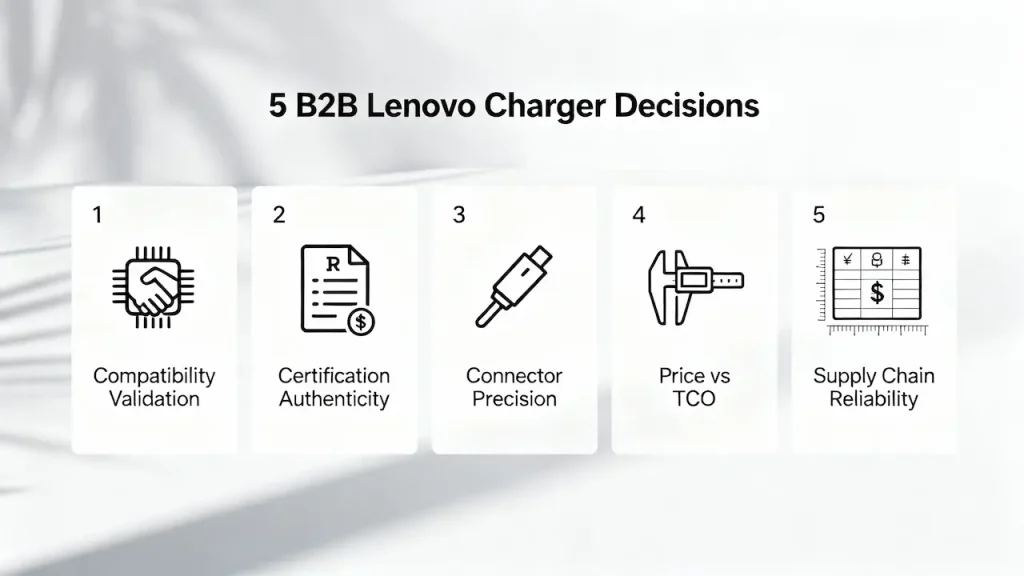
Procuring Lenovo-compatible chargers isn’t just about matching voltage and plug size—it’s a strategic supply chain decision that impacts customer satisfaction, return rates, compliance risk, and gross margin. Based on over 10 years of OEM manufacturing experience serving global aftermarket channels, we’ve identified five non-negotiable dimensions that separate successful B2B buyers from those stuck in a cycle of returns and reputational damage.
4.1 Compatibility Validation: Does It Pass the BIOS Handshake Test?
The single biggest differentiator for Lenovo chargers is firmware-level recognition.
- A charger may output perfect 20V/3.25A—but if it lacks a valid 1-Wire ID chip signature, the laptop will:
- Display: “Unauthorized AC Adapter”
- Limit charging current to ≤0.5A
- Prevent battery charging while under CPU load
✅ Actionable Check: Before placing bulk orders, request a video demo of the unit powering on a ThinkPad E14 or IdeaPad 110 without warnings. Reputable OEMs like [SUP] provide this as standard.
Never assume “it works” based on multimeter readings alone—real-world BIOS behavior is the only true test.
4.2 Certification Authenticity: Can You Verify the Test Reports?
“CE certified” means nothing without proof. In the EU, UK, and Australia, importers are legally liable for non-compliant electronics.
- Demand full certification packages, including:
- IEC/EN 62368-1 safety report (from TÜV, SGS, or UL)
- RoHS 3 declaration with substance testing
- ErP Lot 7 no-load power test (<0.1W)
- Cross-check certificate numbers via official portals (e.g., TÜV Rheinland Certificate Search)
4.3 Connector Precision: Is the 5525 Plug Within ±0.05mm Tolerance?
The 5.5×2.5mm (5525) plug seems simple—but poor tooling causes real-world failures:
- Loose fit → arcing, jack overheating, intermittent disconnects
- Over-tight fit → damage to laptop DC socket (costly motherboard repairs)
At professional OEM facilities, DC plug molds are CNC-machined and regularly calibrated. Inferior suppliers use recycled plastic and worn dies, leading to ±0.2mm variance.
🔧 Pro Tip: Order a physical sample and measure with digital calipers. Insert it into a used Lenovo G50-80 or IdeaPad 110—there should be firm retention with smooth insertion, no wobble.
4.4 Price vs. Total Cost of Ownership (TCO)
Lowest FOB price ≠ highest profit. Consider the true cost per reliable sale:
| Metric | Non-Chip Charger ($4.20) | Chip-Enabled OEM ($6.80) |
|---|---|---|
| Initial Unit Cost | $4.20 | $6.80 |
| Estimated Return Rate | 18–25% | <2% |
| Avg. RMA Handling Cost | $3.50/unit | $0.30/unit |
| Customer Retention Impact | Negative | Positive |
| Effective Cost per Good Sale | $5.40+ | $6.95 |
💡 Insight: The “premium” OEM unit actually delivers higher net margin when factoring in reduced logistics, support labor, and lost future sales.
4.5 Supply Chain Reliability: Can They Support Rolling Forecasts?
One-time samples aren’t enough. Ask your supplier:
- What’s your lead time for repeat orders? (Should be ≤15 days for standard SKUs)
- Do you maintain raw material buffer stock for critical components (e.g., ICs, transformers)?
- Can you accept quarterly blanket POs with monthly releases?
Unstable supply = stockouts during peak repair seasons (back-to-school, post-holiday). At [SUP], we reserve production capacity for strategic B2B partners—ensuring on-time delivery >98% even during component shortages.
5. The Three Most Common Pitfalls for Overseas Distributors Sourcing Lenovo Chargers
Every year, we work with dozens of new B2B clients who’ve suffered avoidable losses—not because they lacked market demand, but because they fell into predictable traps when sourcing Lenovo-compatible chargers from China. These mistakes look minor on paper but cause high return rates, damaged brand reputation, and inventory write-offs. Here are the top three pitfalls—and how to avoid them.
Pitfall #1: “Same Specs = Same Performance” – Ignoring the ID Chip Requirement
Many distributors assume that if a charger lists “20V 3.25A 65W 5525”, it will work flawlessly with ThinkPad or IdeaPad laptops. This is dangerously incorrect.
- Reality: Lenovo’s BIOS performs a digital handshake via a 1-Wire ID chip embedded in genuine/OEM chargers.
- Consequence: Without this chip—even with perfect voltage—the system displays:
“Slow charging. Use the correct AC adapter.”
And limits current to 0.5A, making it useless for practical use. - Real-World Impact: A distributor in Spain ordered 2,000 units of a “65W universal” charger from a B2B platform. After deployment, 68% of end-users reported “not charging”—leading to mass returns and termination of their retail partnership.
✅ Solution: Only source from factories that pre-burn Lenovo-compatible ID signatures and provide BIOS validation reports. Ask: “Can you show a video of this unit working on a ThinkPad E14 without warnings?”
5.2 Pitfall #2: Confusing 45W and 65W Requirements – Leading to System Instability
It’s tempting to stock only 65W adapters “to cover more models.” But forcing a 45W-recommended laptop (like the G50-80 or IdeaPad 110) to run on an underpowered or incompatible supply creates hidden damage.
- What Happens:
- Under light use: battery charges slowly.
- Under load (e.g., Zoom call + Excel): system draws >45W → battery discharges while plugged in.
- Long-term: CPU throttles, user frustration rises, and battery health degrades faster.
- Misconception: “A 65W charger is ‘stronger,’ so it’s safer.”
Truth: If that 65W unit lacks the correct ID profile for a 45W-class device, it may still be rejected or limited by firmware.
✅ Solution: Maintain separate SKUs for 45W (IdeaPad 110/G50-80) and 65W (ThinkPad/IdeaPad 5). Never cross-substitute without BIOS-level verification.
5.3 Pitfall #3: Buying “Factory Direct” Without Verifying Certification or Production Capability
Platforms like Alibaba are flooded with listings claiming:
“China 20V 2.25A 5525 EU Lenovo laptop charger price manufacturers – factory direct!”
But “factory” often means a trading company reselling from unlicensed workshops with:
No in-house ID chip programming
No aging or safety testing
Fake CE/FCC certificates (just PDFs with no test data)
Customs Risk: In 2024, German customs seized €2.3M worth of non-compliant laptop chargers from unverified Chinese suppliers—costing importers fines + storage fees.
Field Failure: Units overheat after 3 months due to recycled capacitors and undersized transformers.
✅ Solution: Conduct due diligence before first order:
- Request factory audit report (or video tour)
- Ask for actual certification numbers (not just logos)
- Order a paid sample and test it on real Lenovo devices
At [SUP], we welcome third-party inspections and provide full compliance documentation—because trust is built on transparency, not promises.
6. Expert Recommendations – How to Build a High-Margin, Low-Risk Lenovo Charger Inventory
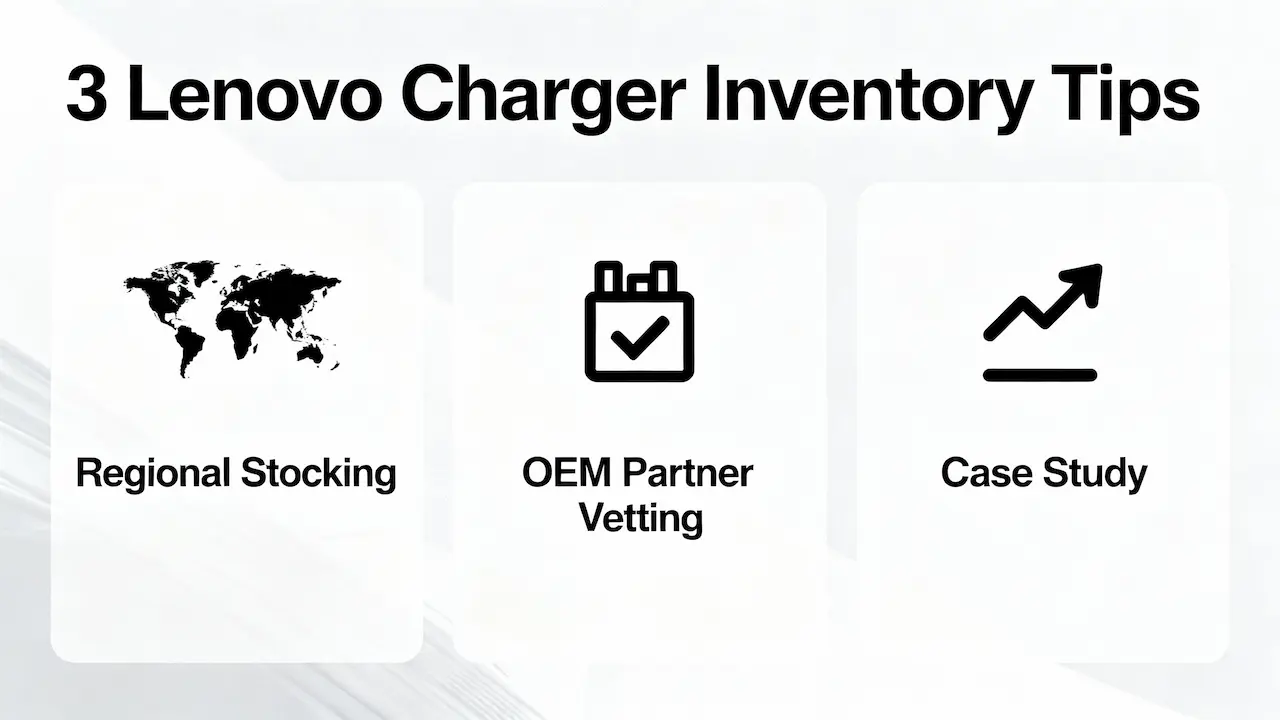
After supporting B2B clients across 40+ countries, we’ve observed a clear pattern: the most profitable distributors don’t just buy cheap—they buy smart. They align their inventory strategy with real-world device lifecycles, regional demand patterns, and technical compatibility requirements. Below are three battle-tested recommendations to help you build a Lenovo charger portfolio that drives repeat sales, minimizes returns, and maximizes gross margin.
6.1 Regional Stocking Strategy: Match SKUs to Local Device Populations
Not all markets need the same mix of chargers. Base your inventory on actual installed base data, not generic assumptions.
Latin America, Africa, Southeast Asia:
- Dominated by entry-level models like Lenovo IdeaPad 110 and G50-80 (shipped in massive volumes 2016–2020).
- Focus SKUs: 45W (20V/2.25A), 5525 plug, ID-chip enabled, CE/FCC certified.
- Avoid over-investing in USB-C PD—adoption remains low outside premium segments.
Europe & North America:
- Higher penetration of ThinkPad E/T/X series and Yoga models (2020+).
- Dual-track approach:
- Maintain 65W 5525 stock for legacy repairs
- Gradually shift budget toward USB-C PD 65W GaN units (compatible with ThinkPad X1, Yoga Slim 7)
📊 Pro Tip: Use local repair shop surveys or eBay sold listings to estimate model prevalence. For example, if “G50-80 charger” has 5x more monthly searches than “ThinkPad T14 charger” in your country, allocate 70% of your Lenovo budget to 45W 5525 units.
6.2 Partner Only with Factories That Have Proven Lenovo OEM Experience
Not every “charger manufacturer” can deliver true Lenovo compatibility. Vet suppliers using these criteria:
✅ ID Chip Programming Capability
- Do they have in-house 1-Wire EEPROM burners?
- Can they customize ID signatures per model family (e.g., G-series vs. ThinkPad)?
✅ Certification Ownership
- Do they hold active IEC 62368-1 certificates under their own factory name? (Not resold from another company)
✅ Test Infrastructure
- Do they perform 8–24 hour aging tests at 40°C ambient?
- Do they validate BIOS handshake on real Lenovo devices before shipment?
🔍 Red Flag: If a supplier says, “We can make it work—just tell us the specs,” they lack deep Lenovo integration experience. True OEM partners already know the required ID profiles and test protocols.
At [SUP], we maintain a Lenovo-specific production line with dedicated firmware validation stations—ensuring every unit passes real-device testing before packing.
6.3 Case Study: How a Middle Eastern Distributor Cut Returns by 92% and Tripled Reorders
Client Profile: Regional electronics distributor serving 200+ repair shops across UAE, Saudi Arabia, and Egypt. Previously sourced “universal” 65W chargers from multiple Chinese suppliers.
Problem:
- 22% return rate due to “not charging” complaints
- Repair shops switched to competitors offering “guaranteed Lenovo-compatible” units
Solution Implemented with [SUP]:
- Switched to chip-enabled 45W and 65W 5525 chargers with pre-burned Lenovo ID signatures
- Required batch-level test reports showing successful BIOS handshake
- Started offering a 12-month functional warranty (backed by our reliability data)
Results After 6 Months:
- Return rate dropped to 1.8%
- Average order value increased by 37% (due to trust in compatibility)
- Client became exclusive supplier for 3 major repair chains
💡 Key Takeaway: Reliability = pricing power. Once your customers trust your Lenovo chargers “just work,” you can command a 15–25% price premium over generic alternatives—and enjoy sticky, recurring revenue.
7. Conclusion: Mastering Model-Level Details Is the Key to Profit and Trust
Lenovo laptop chargers are not commodities—they are engineered components embedded in a tightly controlled ecosystem. The difference between a 4“universal”adapteranda6.80 OEM-compatible unit isn’t just cost; it’s customer trust, return rates, and brand reputation.
As global regulations tighten (e.g., the EU’s 2026 USB-C mandate) and end-users become more tech-savvy, the aftermarket will increasingly reward suppliers who prioritize technical accuracy over short-term savings. While entry-level models like the IdeaPad 110 and G50-80 will continue driving demand for 45W 5525 chargers through 2028 and beyond, only those who understand the nuances—ID chips, certification validity, connector tolerances—will capture sustainable margin.
At [SUP], we don’t sell “chargers.” We deliver certified-compatible power solutions backed by 15+ years of OEM manufacturing discipline, real-device validation, and supply chain transparency. Our mission is simple: ensure every unit you stock becomes a reason your customer comes back—not a reason they leave.
👉 Explore our full range of OEM laptop power adapters engineered for Lenovo and other major brands—with model-specific ID authentication, regional certifications, and bulk-ready inventory.