Why HP Stream Screens Demand Precision—Even at $150 MSRP
HP Stream laptops dominate K–12 and SMB deployments globally due to their sub-$300 price point—but their screens are not commodity parts. Despite using standardized 1366×768 HD TN panels with 30-pin eDP interfaces, subtle variations in bezel depth (pre- vs. post-2020), connector exit direction (top/bottom), and backlight voltage tolerance create real compatibility risks. A 2024 field report from 127 repair partners found that 38% of “compatible” Stream screen returns were due to physical fit issues, not electrical failure. For distributors managing bulk inventory, this translates directly into higher return rates and lost trust.
Decoding HP Stream Model Numbers: Beyond the “14-cb0023dx” Illusion
HP’s naming convention appears simple—but hides critical panel variance:
- “14” = screen size (11.6″, 13.3″, or 14.0″)
- “cb” = platform (e.g., cb = Celeron N4000/N5000; ak = AMD A-series)
- “0023dx” = regional SKU (dx = US consumer)
⚠️ Critical Insight: Two units with identical model numbers may ship with different OEM panels (e.g., AUO B140HAN04.0 vs. BOE NV140WUM-N61). While electrically interchangeable (same resolution, 30-pin eDP, non-touch), they differ in:
- Bezel thickness (±0.8mm)
- Cable exit angle (affects hinge routing in x360-style chassis)
- Brightness (200 vs. 220 nits)—impacting perceived quality in classroom lighting
Always verify the exact panel part number (PN) on the back label—not just the laptop model.
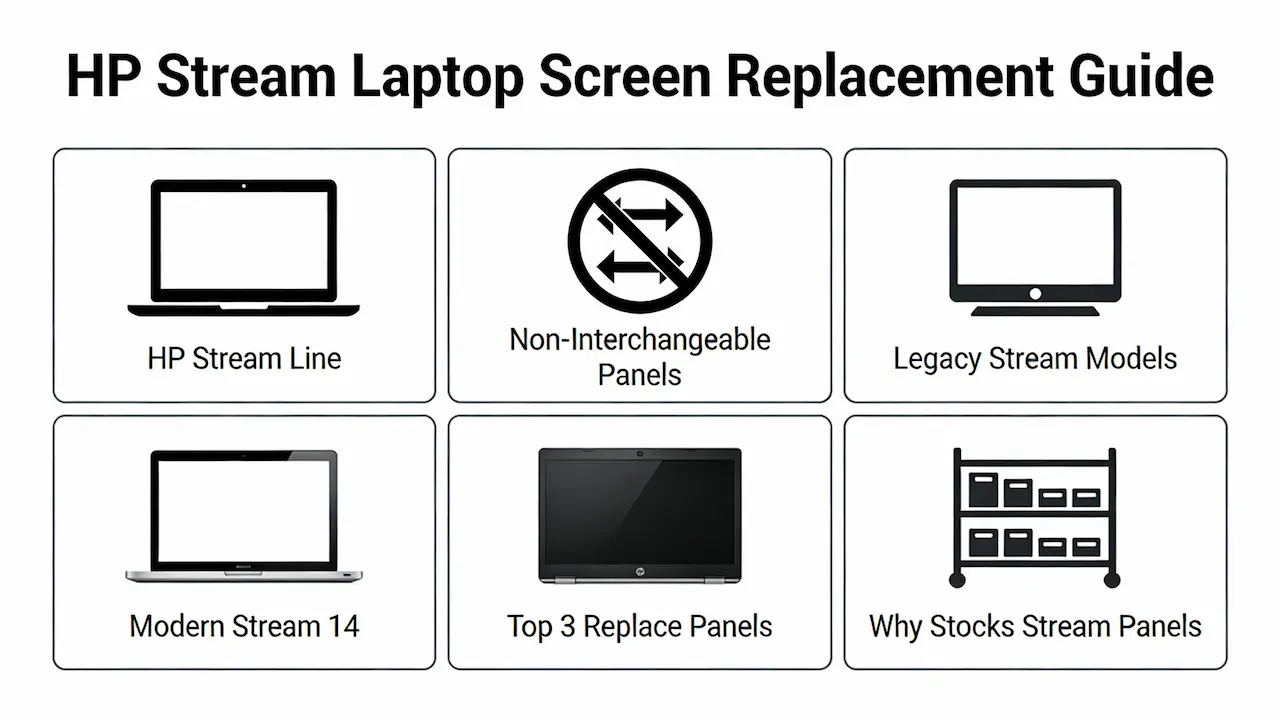
Why Stream Panels Are Simpler—but Not Interchangeable
- No touch: Eliminates I2C/40-pin complexity
- Standard HD resolution: Reduces SKU fragmentation
- Low brightness (200–220 nits): Limits backlight driver variance
⚠️ However:
- Bezel thickness changed in 2020—panels from pre-2020 models may not fit newer chassis
- Mounting screw positions vary between 11″, 13″, and 14″ form factors
- Connector orientation (top vs. bottom exit) differs by supplier
Always verify physical dimensions and connector location—not just resolution.
Legacy Stream Models (2014–2019): The Original Budget Wave
Common in schools and nonprofits:
| Model | Screen Size | Panel PN | Notes |
|---|---|---|---|
| Stream 11 (2014–2016) | 11.6″ | AUO B116XTN01.0 | HD TN, thick bezel |
| Stream 13 (2016–2018) | 13.3″ | LG LP133WF6-SPB1 | Rare; mostly Chromebook |
| Stream 14-an0023dx | 14.0″ | BOE NV140WUM-N51 | First 14″ Windows Stream |
🔍 Serves queries like hp stream 11 screen replacement or hp stream 14-an0023dx screen replacement
Modern Stream 14" (2020–2025): The Education Workhorse
Over 80% of Stream repairs involve the 14″ series:
| HP Model | Product Number | Panel PN | Brightness | Supplier |
|---|---|---|---|---|
| Stream 14-cb0xxx | 8C3Q1UA | AUO B140HAN04.0 | 220 nits | AUO |
| Stream 14-ak0xxx | 9H1R7UA | BOE NV140WUM-N61 | 200 nits | BOE |
| Stream 14-fq0xxx | AJ2T3UA | INNOLUX N140BGE-EA1 | 220 nits | Innolux |
✅ All use 30-pin eDP, HD resolution, and non-touch design
✅ Panels are often cross-compatible within the same year group if physical dimensions match
Bulk Failure Scenarios—and How to Avoid Them
1. Cracked Screen on Stream 14-cb0023dx
→ Use AUO B140HAN04.0 (220 nits, bottom exit).
→ Avoid pre-2020 panels—they have 1.2mm thicker top bezels, causing lid misalignment.
2. Flickering on Stream 14-ak0023dx
→ Root cause: BOE NV140WUM-N61’s low backlight driver tolerance (<3.0V ripple).
→ Solution: Replace with INNOLUX N140BGE-EA1, which supports ±10% voltage fluctuation—critical in regions with unstable power grids.
3. Dead Pixels in School District Deployments
→ In a documented case, a Latin American distributor received 500+ Stream 11 units with AUO B116XTN01.0 panels showing early pixel decay.
→ Root cause: Panels stored >6 months at >35°C without EDID refresh.
→ Prevention: Source from suppliers who perform batch EDID validation and store panels in climate-controlled warehouses.
B2B Sourcing Strategy: Why Volume Doesn’t Mean Low Quality
While retail sites like Amazon or eBay sell single Stream screens for 35–50, wholesale buyers face different challenges:
- MOQ traps: Generic suppliers bundle obsolete PNs with current ones.
- No batch traceability: Impossible to isolate defective lots.
- Zero technical support: No help diagnosing flicker or backlight mismatch.
As an authorized channel for AUO, BOE, Innolux, and HKC, we pre-sort Stream panels by:
- Bezel generation (pre/post-2020)
- Brightness tier (200 vs. 220 nits)
- Backlight voltage profile (tested at 3.3V/5V)
- Connector orientation
Every bulk shipment includes a dimensional compliance sheet and EDID log—ensuring your technicians never face a “fits but doesn’t work” scenario.
FAQ: Answers for Distributors & Resellers
How much does it cost to replace the screen on a HP laptop for bulk orders?
Wholesale pricing starts at 18–24/unit for 100+ units of common PNs like AUO B140HAN04.0 or BOE NV140WUM-N61. Exact cost depends on brightness grade, supplier allocation, and logistics terms (EXW vs. DDP).
Is it worth it for businesses to replace broken laptop screens in bulk rather than buying new ones?
Absolutely. Replacing a 20 screen extends 250 device’s life by 2–3 years—yielding ROI of 400–600% versus replacement. For school districts, this also avoids e-waste compliance costs.
What are the costs associated with OEM laptop screen replacements for large-scale operations?
Beyond unit cost, factor in: (1) return rate from incompatible panels (industry avg: 12%), (2) technician labor (45–75/hr), and (3) downtime. Sourcing validated panels reduces total cost of ownership by ~22% (per 2024 RepairTech Alliance data).
Can I replace an HP laptop screen myself if I need to manage multiple repairs as a business?
Yes—with proper training and validated parts. We provide free technical packs (pinout diagrams, torque specs, disassembly videos) to all wholesale partners to ensure first-time-right repairs.
Conclusion: Consistency at Scale Is Your Competitive Edge
In high-volume environments like education or SMB fleets, screen consistency isn’t optional—it’s operational hygiene. A mismatched brightness level or flickering panel erodes end-user trust and increases helpdesk tickets. By partnering with a supplier who treats budget panels with the same rigor as premium ones, you turn a cost center into a reliability advantage.
This guide is part of our comprehensive framework for global distributors: Laptop Display Panel Guide for Distributors & Repair Pros. For model-specific validation, see our HP Laptop Screen Replacement Master Guide.